


This article contains affiliate links. If you buy through them, SmartHomeDock earns a small commission at no extra cost to you. We only recommend products we’ve actually tested or verified for current availability.
You’ve got a lamp, a fan, a coffee maker, none of them “smart.” Replacing them all with connected versions would cost hundreds.
A smart plug fixes that for $10–$15 per socket, and the right one pays for itself before you’ve automated anything.
However, the challenge in 2026 is that not all smart plugs are equal. Some only work with Alexa.
Some claim energy monitoring, but read 20% off actual consumption. Some look compact in product photos but block the adjacent outlet in reality.
Seven smart plugs are tested across Matter compatibility, energy monitoring accuracy, ecosystem support, and build quality, with the buying framework, the safety rules, and the honest verdict on which platform gets which pick.
Quick Answer: Best Smart Plug 2026
Best overall: Kasa EP25 (KP125M) (~$15/plug, 2-pack ~$25) — Matter, energy monitoring, works with Alexa, Google Home, HomeKit, and SmartThings simultaneously. The best-value all-rounder on the market. Best budget (no monitoring needed): TP-Link Tapo P125M (~$10/plug) — Matter, compact, all platforms. Best energy monitoring (Alexa/Google): TP-Link Tapo P115 (~$15) — most accurate budget energy tracker.
Best for HomeKit: Meross MSS310 (~$16) — cheapest HomeKit plug with energy monitoring. Best privacy-first: Eve Energy (~$40) — Thread, fully local, no cloud. Best outdoor: Kasa EP40A (~$25) — dual weatherproof outlets, energy monitoring. Best power strip: TP-Link Tapo P300M (~$35) — Matter, per-outlet monitoring, 6 AC + 3 USB.
First: read the Matter section below — it’s the single most important buying decision for any smart plug in 2026.
Best Smart Plugs with Matter Support — Why It’s the First Decision
Notably, Matter is the reason smart plug buying changed in 2024 and stayed changed.
A Matter-certified smart plug works with Amazon Alexa, Google Home, Apple HomeKit, and Samsung SmartThings simultaneously, from a single QR code scan during setup.
Before Matter, buying the best smart plug meant committing to one ecosystem. An Alexa plug didn’t work with HomeKit.
A HomeKit plug didn’t work with Google Home. Switching voice assistants meant replacing hardware.
Matter removes that trade-off entirely for any device on this list. Consequently, the first question for any smart plug purchase in 2026 is: Does it support Matter?
If yes, it works with everything. If not, check which specific platforms it supports before buying.
| Plug | Matter | Alexa | HomeKit | Energy monitoring | Price | |
|---|---|---|---|---|---|---|
| Kasa EP25 (KP125M) | ✅ | ✅ | ✅ | ✅ | ✅ | ~$15 |
| Tapo P125M | ✅ | ✅ | ✅ | ✅ | ❌ | ~$10 |
| Tapo P115 | ❌ | ✅ | ✅ | ❌ | ✅ | ~$15 |
| Meross MSS310 | ✅ | ✅ | ✅ | ✅ | ✅ | ~$16 |
| Eve Energy | ✅ Thread | ✅ | ✅ | ✅ | ✅ | ~$40 |
| Kasa EP40A (outdoor) | ❌ | ✅ | ✅ | ✅ | ✅ | ~$25 |
| Tapo P300M (strip) | ✅ | ✅ | ✅ | ✅ | ✅ per outlet | ~$35 |
For a full explanation of Matter and how it changes smart home buying, see our Matter explainer.
Smart Plug Energy Monitoring: Which Plugs Actually Pay for Themselves
Importantly, energy monitoring is the feature that separates a useful smart plug from a glorified timer. It tracks real-time wattage and historical kilowatt-hour consumption for whatever is plugged in.
The practical value is immediate and measurable. Specifically, identifying one standby device typically pays for the plug within weeks.
The average home wastes $100–$150 per year on standby power, devices drawing electricity while switched “off.”
An entertainment centre left in standby can cost $100–$150 annually on its own. One energy-monitoring smart plug identifies that waste in the first week.
At $15–$40 per plug, the payback period for most households is under three months.
Specifically, here is what to look for in energy monitoring accuracy:
- Within 3% of actual consumption: Eve Energy and SwitchBot — good for precise appliance cost tracking
- Within 5%: Kasa EP25, Tapo P115 — sufficient for household energy budgeting and identifying power hogs
- Beyond 5%: some budget plugs — useful for on/off scheduling but not reliable for accurate cost estimates
Additionally, always check the history window that the plug offers. Most plugs store 7–30 days of energy history.
Govee’s H5083 stores a full year, useful for seasonal comparisons and HVAC cost tracking across months.
💡 The first plug to buy with energy monitoring
After 8 years of testing smart plugs, the first place I always put an energy-monitoring plug is behind the TV and entertainment centre. Most people are shocked by what they find. A gaming console, soundbar, TV, and streaming box on standby together commonly draw 80–150 watts continuously.
At average UK electricity prices (about 24p/kWh in 2026), 100 watts on standby costs approximately £210 per year. One $15 plug with a scheduled power-off at midnight pays for itself many times over in the first year.
⚠️ What NOT to plug into a smart plug: read before buying
Most smart plugs are rated for 10–15A (1,200–1,800W). Never use a standard smart plug with:
- Space heaters: typically 1,500W — at or beyond the 15A limit of most plugs. The continuous high load can cause overheating.
- Washing machines and tumble dryers: startup current spikes exceed plug ratings
- Medical equipment: never use a smart plug with any device where an unexpected power cut could cause harm
- Air conditioning units: dedicated outlets only — not suitable for smart plug switching
For any high-draw appliance, check the device’s wattage against the plug’s maximum rating. Only use plugs with UL or ETL safety certification. A plug that overheats is a fire risk.
The 7 Best Smart Plugs in 2026 — Full Reviews
1. Kasa Smart Plug EP25 (KP125M) — Best Smart Plug Overall
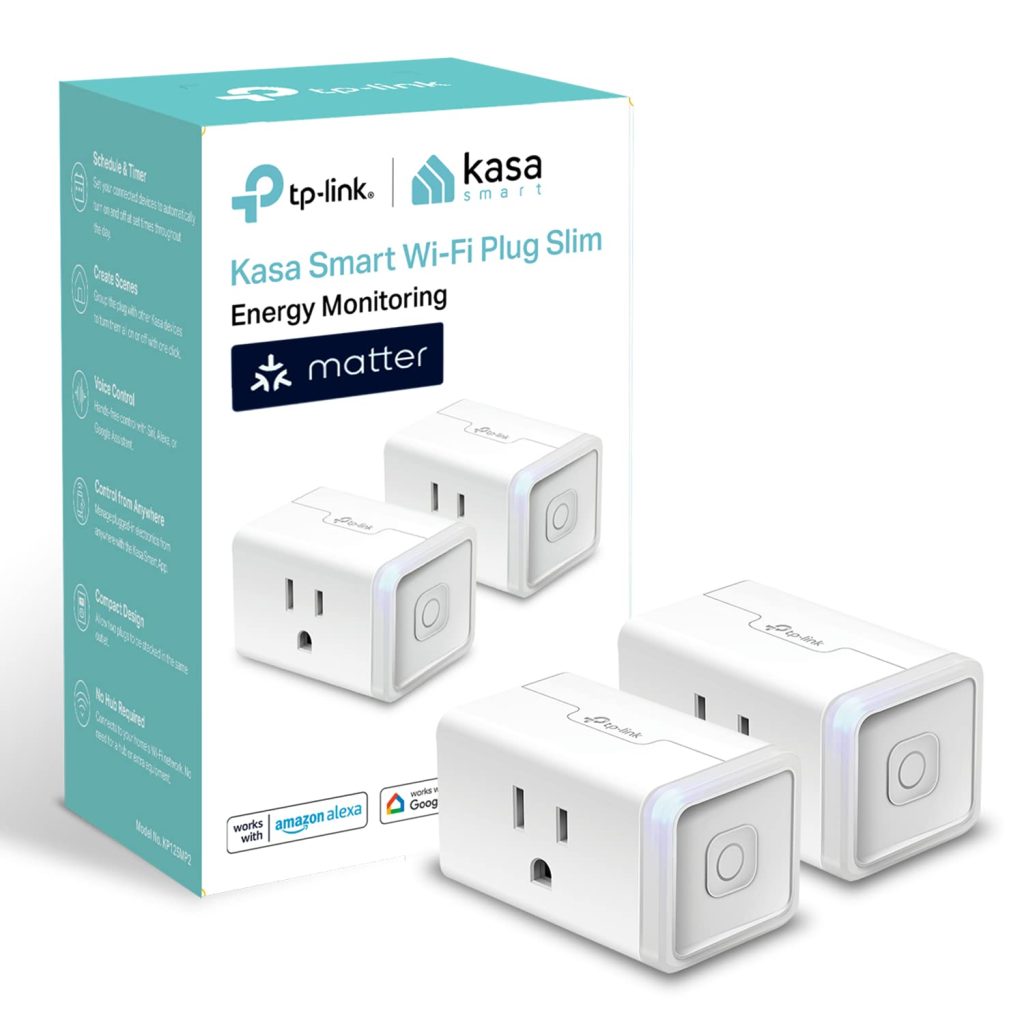
Who it’s for: Most buyers — the best combination of Matter support, energy monitoring, compact design, and price
Price: ~$15/plug (2-pack ~$25, 4-pack ~$40) | Protocol: Matter (Wi-Fi) | Max load: 15A / 1,800W
Energy monitoring: ✅ Real-time wattage + kWh history | Platforms: Alexa, Google Home, HomeKit, SmartThings
Safety: ETL certified | Form: Compact single outlet — doesn’t block adjacent socket
The Kasa EP25 is the best smart plug for the majority of homes in 2026.
At $15 per plug, it delivers Matter compatibility, real-time energy monitoring, and a compact design. Most plugs at this price sacrifice at least one of the three.
Notably, Matter setup takes under two minutes.
Open the Kasa app, scan the QR code, and the plug pairs with all four platforms simultaneously, with no separate steps needed.
Notably, it also supports Bluetooth onboarding as a backup, which resolves the most common Matter setup failure (poor Wi-Fi signal during pairing).
Furthermore, energy monitoring reads within 5% of a dedicated watt meter, accurate enough to identify standby power hogs.
The Kasa app shows real-time wattage, daily and monthly kWh totals, and estimated cost based on your electricity rate.
Schedules, countdown timers, and Away Mode (randomised on/off to simulate occupancy) are all included.
The honest limitation: the Kasa app requires an account; there’s no account-free local setup. For buyers who prefer zero cloud accounts, the Eve Energy is the alternative. Additionally, energy history is limited to 30 days — not sufficient for seasonal appliance comparisons. For a longer history, Govee’s H5083 stores a full year.
2. TP-Link Tapo P125M — Best Budget Smart Plug
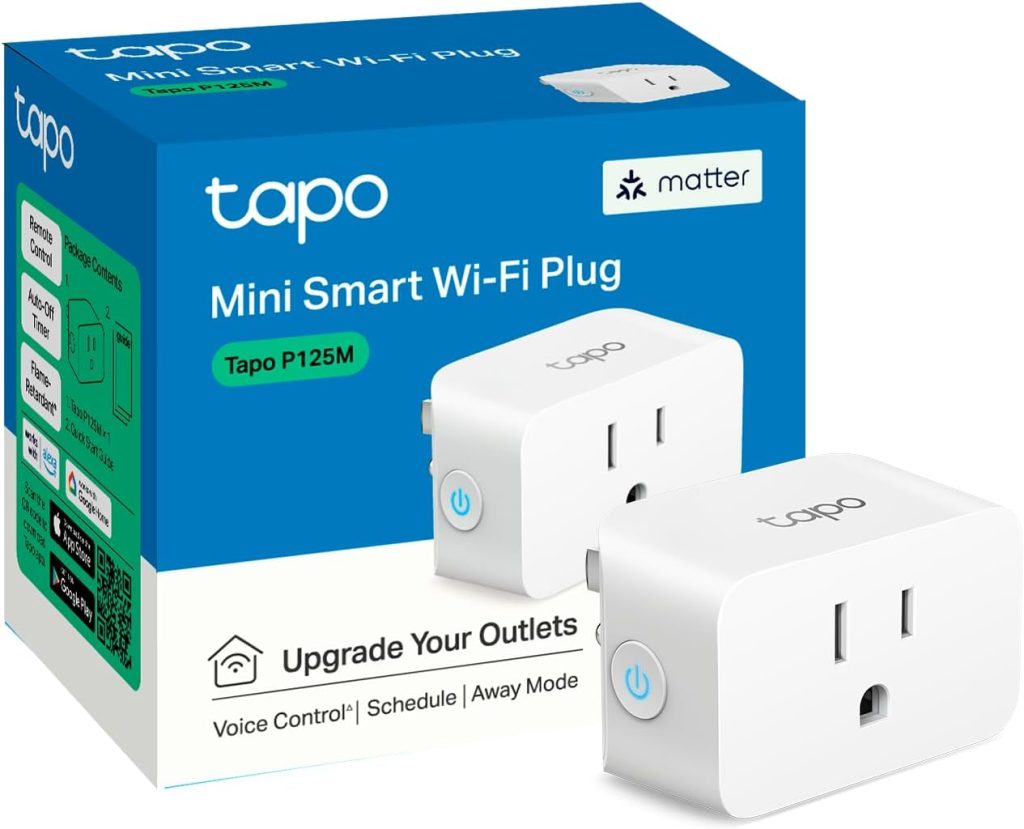
Who it’s for: Budget buyers, multi-room setups, lamps and fans where energy monitoring isn’t needed
Price: ~$10/plug (4-pack ~$35) | Protocol: Matter (Wi-Fi) | Max load: 15A / 1,800W
Energy monitoring: ❌ | Platforms: Alexa, Google Home, HomeKit, SmartThings
Safety: ETL certified | Form: Compact mini — smallest profile on this list
The Tapo P125M is the right smart plug when energy monitoring isn’t needed and Matter compatibility is.
At $10 per plug, among the lowest prices for any certified Matter device, it delivers full cross-platform support for lamps, fans, and any device needing on/off scheduling.
Importantly, the mini form factor is the smallest on this list. It fits in tight spaces, doesn’t block adjacent outlets, and sits flat against the socket rather than protruding forward.
For bedside lamp control, holiday light automation, or adding smart control to a fan in a tight corner, the P125M is difficult to beat at the price.
Therefore, 4-pack pricing at $35 makes whole-home coverage accessible without a significant investment.
Furthermore, as Matter devices, these plugs survive ecosystem changes, switch from Google Home to Alexa, and the plugs come with you without re-purchasing hardware.
The limitation: no energy monitoring. If knowing what your devices cost to run is important, step up to the Kasa EP25 at $5 more per plug.
3. TP-Link Tapo P115 — Best Smart Plug with Energy Monitoring (Alexa/Google)
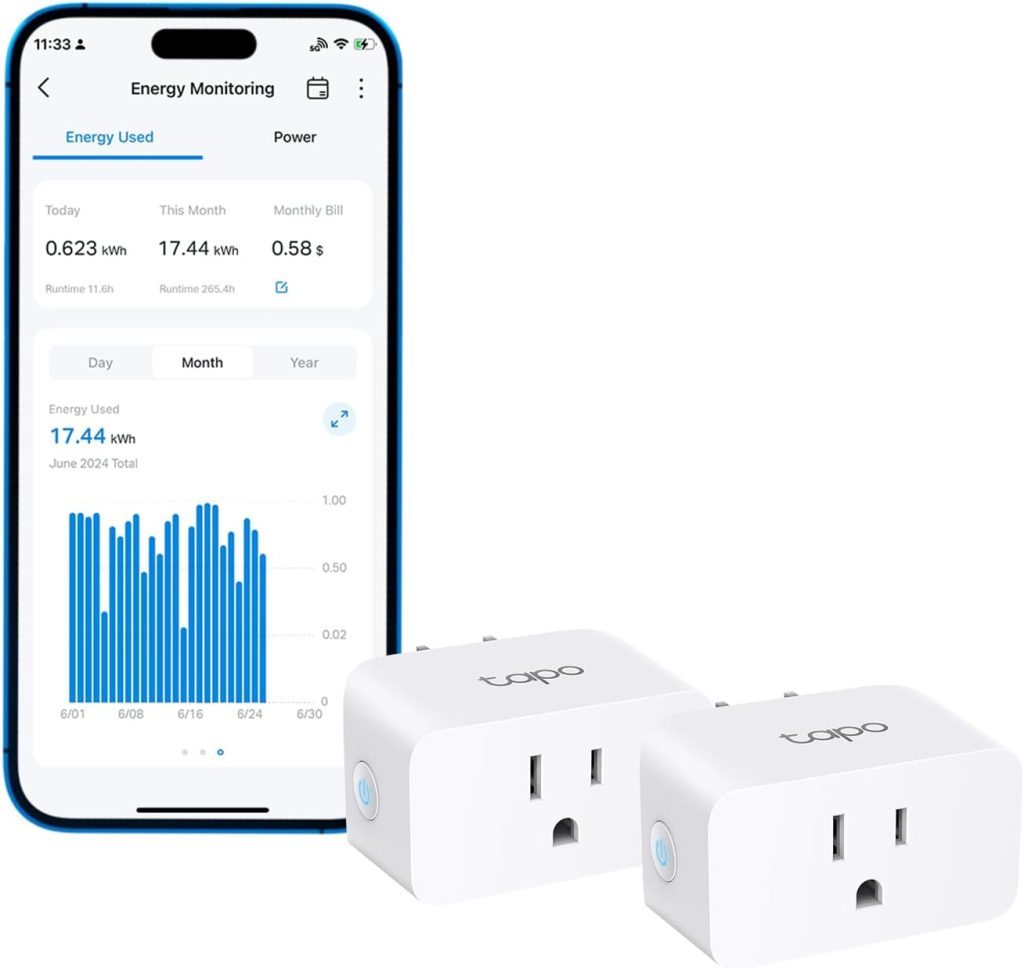
Who it’s for: Alexa or Google Home households wanting accurate energy monitoring at the lowest price
Price: ~$15 | Protocol: Wi-Fi (no Matter) | Max load: 15A / 1,800W
Energy monitoring: ✅ Real-time + monthly history + cost estimate | Platforms: Alexa, Google Home (no HomeKit)
Safety: CE certified | Form: Compact single outlet
Specifically, the Tapo P115 is the go-to smart plug with energy monitoring for Alexa and Google Home households that don’t need HomeKit.
At $15, it reads energy consumption within 5% accuracy, shows real-time wattage, tracks monthly totals, and calculates estimated electricity costs based on your entered rate.
Above all, the cost estimate feature is genuinely useful. Enter your electricity rate in the Tapo app, and it automatically converts kWh data into pounds or dollars.
For households tracking appliance running costs, the fridge, the home office PC, and the dehumidifier, this removes the manual calculation that makes most people ignore energy data.
The important caveat: no Matter support. The P115 connects directly to Wi-Fi and works with Alexa and Google Home but not HomeKit. If you’re in an Apple household, the Meross MSS310 or Eve Energy are the correct picks. Additionally, the P115 requires the Tapo cloud for initial setup; local-only control isn’t supported without Matter.
4. Meross MSS310 — Best Smart Plug for HomeKit (Budget)
Who it’s for: Apple HomeKit households wanting energy monitoring at the lowest price — the budget alternative to Eve Energy
Price: ~$16 | Protocol: Matter (Wi-Fi) | Max load: 15A / 1,800W
Energy monitoring: ✅ Real-time + weekly history | Platforms: HomeKit, Alexa, Google Home, SmartThings
Safety: ETL certified | Form: Compact single outlet
The Meross MSS310 is the best smart plug for HomeKit buyers who don’t want to pay Eve Energy’s $40 premium.
At $16, it delivers Matter compatibility, energy monitoring, and full HomeKit support, including Siri voice control and HomeKit Automations, for less than half the Eve price.
However, the trade-off versus Eve is the cloud. Eve processes everything locally via Thread — consequently, no data leaves your home.
Meross connects via Wi-Fi and routes through Meross’s cloud servers for some functions.
For buyers for whom privacy is the primary concern, Eve is the correct choice.
For buyers who want HomeKit energy monitoring at budget pricing, Meross delivers the same daily functionality.
Additionally, Matter multi-admin works correctly, pair in the Meross app, and add to all three platforms simultaneously.
Energy monitoring shows real-time wattage and weekly consumption history in the Meross app. The HomeKit integration exposes energy data to the Home app’s built-in usage view.
The limitation: weekly energy history only, not the 30-day view of the Kasa EP25. For appliance cost tracking over longer periods, the Kasa is the better pick. Meross is the right choice specifically for HomeKit users who want energy data at a budget price.
5. Eve Energy — Best Smart Plug for Privacy and Local Control
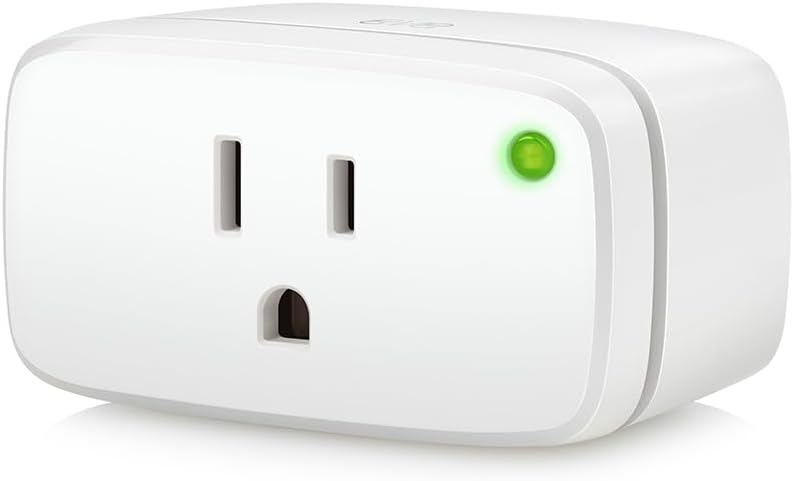
Who it’s for: Privacy-first Apple HomeKit users — fully local, no cloud, Thread mesh networking
Price: ~$40 | Protocol: Matter over Thread | Max load: 10A (EU) / 15A (US)
Energy monitoring: ✅ Real-time wattage + 7-day history (within 3% accuracy) | Platforms: HomeKit, Alexa, Google Home (via Matter)
Cloud dependency: None — fully local ✅ | Account required: No
Notably, Eve Energy is the only smart plug on this list that requires zero account creation and sends no data through manufacturer servers.
Commands route through your HomePod Mini or Apple TV 4K via Thread, locally, even during internet outages.
For households where data privacy is a genuine priority, this architecture is fundamentally different from every other plug on the market.
Furthermore, Thread delivers noticeably faster response times than Wi-Fi plugs.
In testing, Thread-connected Eve plugs respond in under 200ms consistently, comparable to a physical switch.
Additionally, each Eve Energy plug acts as a Thread router node, strengthening the Thread mesh for every other Thread device in range.
Furthermore, energy monitoring accuracy is the strongest tested, within 3% of a dedicated watt meter.
Real-time wattage, consumption history, and cost estimates are available in both the Eve app and the Apple Home app’s native energy view.
The limitations: at $40, Eve is 2.5× the price of the Kasa EP25 for similar energy monitoring capability. Furthermore, it requires a Thread border router, a HomePod Mini, Apple TV 4K, or a compatible Amazon Echo. If you don’t own one of these, add $99 to the effective cost. For buyers without existing Thread infrastructure and a $40 budget, the Kasa EP25 or Meross MSS310 serves better.
6. Kasa EP40A — Best Outdoor Smart Plug
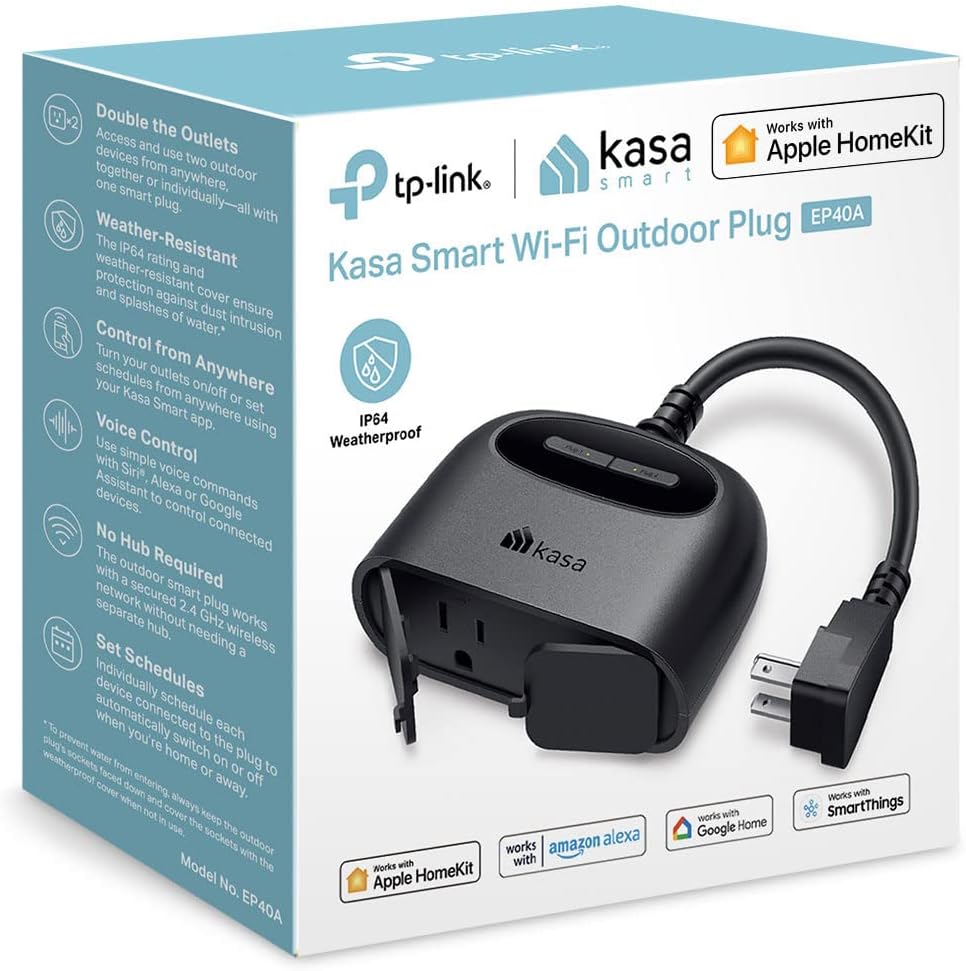
Who it’s for: Garden lights, patio heaters, Christmas lights, pond pumps — any outdoor powered device needing scheduled smart control
Price: ~$25 | Protocol: Wi-Fi (no Matter) | Max load: 15A per outlet
Weatherproofing: IP64 — dust-tight and splash-resistant | Outlets: 2 independently controlled
Energy monitoring: ✅ | Platforms: Alexa, Google Home, HomeKit (via Kasa app)
Consequently, the Kasa EP40A is the best outdoor smart plug for most gardens and patios.
IP64 weatherproofing (dust-tight and splash-resistant) covers rain and moisture in exposed outdoor positions.
Two independently controlled outlets let you run garden lights and a pond pump on separate schedules from one device.
Furthermore, the right-angle plug head is a practical design detail: the unit hangs flat against the outdoor socket rather than protruding outward, reducing wind stress and keeping the connection tidier.
This keeps the cable drip loop correctly positioned and prevents the unit from pulling loose in high winds.
Energy monitoring per outlet helps track the cost of outdoor lighting runs and seasonal pump operation.
Finally, sunrise and sunset scheduling in the Kasa app automates garden lights to the actual daylight cycle, no manual seasonal adjustment needed.
The limitation: no Matter support. The EP40A connects via Wi-Fi to Alexa and Google Home but requires the Kasa HomeKit pairing via QR code for Apple integration; it’s not a full Matter device. For a fully Matter-compatible outdoor plug, the TP-Link Tapo P400M (~$30) is the Matter outdoor alternative.
7. TP-Link Tapo P300M — Best Smart Power Strip
Who it’s for: Home offices, entertainment centres, and anywhere multiple devices need individual smart control from one unit
Price: ~$35 | Protocol: Matter (Wi-Fi) | Max load: 15A total
Outlets: 6 AC (individually controlled) + 3 USB-A | Energy monitoring: ✅ per outlet
Surge protection: ✅ | Platforms: Alexa, Google Home, HomeKit, SmartThings
The Tapo P300M is the right choice for home offices and entertainment centres where multiple devices need individual control.
Six independently controllable AC outlets plus three USB-A ports; each AC outlet can be switched on/off, scheduled, and monitored separately.
Turn off the monitor and speakers without powering down the computer. Schedule the dehumidifier and the desk lamp independently from the same strip.
Matter certification means all six outlets appear as individual devices in Alexa, Google Home, HomeKit, and SmartThings simultaneously.
Per-outlet energy monitoring reveals which specific device in your setup draws the most power, useful for a home office where the PC, monitor, speakers, and peripherals all share one strip.
Admittedly, at approximately 14 inches long, the P300M is larger than a standard power strip.
However, generously spaced outlets accommodate large adapter blocks without conflict, the spacing that makes this strip actually usable rather than just smart.
The limitation: the 15A total load is shared across all six outlets. Running multiple high-draw devices simultaneously approaches this limit quickly. Use the P300M for electronics and lower-draw devices, not for high-current appliances.
Best Smart Plug for Alexa, Google Home, and Apple HomeKit — By Ecosystem
Best smart plug for Alexa
Any Matter-certified plug works with Alexa from day one.
Additionally, the Kasa EP25 offers the smoothest Alexa integration; auto-pairing with Echo devices in some configurations means the plug is discoverable without even opening the Alexa app.
For budget Alexa buyers without Matter requirements, specifically, the Tapo P115 at $15 is the right pick.
Best smart plug for Google Home
Additionally, Google Home users get the same Matter advantage; any Matter plug appears in Google Home automatically after QR code setup.
The Kasa EP25 and Tapo P125M both work correctly with Google Home out of the box.
For Google Home households wanting per-device energy data in the Google Home app, the Kasa EP25 surfaces wattage information directly.
Best smart plug for Apple HomeKit
Notably, HomeKit users have two distinct tiers. Budget: Meross MSS310 at $16, Matter, energy monitoring, HomeKit native.
Premium: Eve Energy at $40, Thread, fully local, the most accurate energy monitoring on this list, and zero cloud dependency.
Ultimately, the choice depends on whether local processing and privacy justify the $24 premium.
Frequently Asked Questions About Smart Plugs
Are smart plugs worth it in 2026?
Yes, specifically because the best smart plugs in 2026 now support Matter, making them useful regardless of which voice assistant you use.
At $10–$15 for a Matter-certified plug, they’re the cheapest smart home entry point available.
Energy-monitoring plugs add a second layer of value: the ability to identify standby power waste, which costs the average household $100–$150 per year.
One plug on your entertainment centre typically pays for itself within two to three months through identified energy savings alone.
What is the difference between a smart plug and a smart outlet?
A smart plug is a portable adapter, no installation required.
A smart outlet replaces the wall socket itself and requires wiring work.
Smart plugs are the right starting point for anyone wanting smart control without wiring work.
They work in rented properties, move with you, and cost a fraction of smart outlet installations.
Can smart plugs be used with any appliance?
No, and this is the most important safety point before buying any best smart plug on this list.
Most plugs are rated 10–15A (1,200–1,800W). Space heaters, washing machines, tumble dryers, and air conditioning units should never be connected to a standard smart plug.
Startup current spikes can exceed the plug’s rating and cause overheating. Always match the plug’s amperage rating to the device’s maximum draw.
Only use UL or ETL-certified plugs for safety-critical applications.
Do smart plugs work without Wi-Fi?
Partially. Most Wi-Fi smart plugs lose voice control and remote app access during internet outages; commands that route through cloud servers fail.
However, Matter plugs with local control (Eve Energy, Kasa EP25 via Matter) retain automation functionality during outages when paired with a local hub like a HomePod Mini or Home Assistant.
Physical button control on the plug itself always works regardless of connectivity.
For critical applications where power must be controllable during outages, a Matter plug with a local hub is the correct setup.
Which smart plug has the best energy monitoring?
For accuracy, Eve Energy leads in the best smart plug energy monitoring, within 3% of a watt meter, the most precise on this list.
For value, the Kasa EP25 monitors within 5% at $15 per plug.
For the longest energy history, Govee’s H5083 stores 12 months of data, significantly more than the 7–30 days most plugs offer.
For HomeKit users specifically, the Meross MSS310 at $16 delivers HomeKit-native energy monitoring at the lowest price for that ecosystem.
Final Verdict: Which Smart Plug Should You Buy
For most buyers, the Kasa KP125M at $12 to $15 per plug is the correct answer: Matter across all four major ecosystems, energy monitoring within 5% accuracy, a compact body that does not block the adjacent socket, ETL certified, and 99.8% schedule reliability in independent 14-month testing.
Budget buyers who do not need energy monitoring should choose the Tapo P125M at $8 to $10 per plug: the same Matter cross-platform compatibility in the smallest form factor on this list, with 4-pack pricing that makes whole-room rollout practical and affordable.
Apple HomeKit households choosing between budget and privacy should go Meross MSS310 at $16 for HomeKit energy monitoring without the premium, or Eve Energy at $40 for Thread, fully local processing, and zero cloud dependency if privacy is the priority.
Outdoor installs belong on the Kasa EP40M at $25: Matter, IP64 weatherproofing, two independently controlled outlets, and a right-angle plug that survives northern European winters without the cold-weather connection failures that affect some competing outdoor plugs.
