


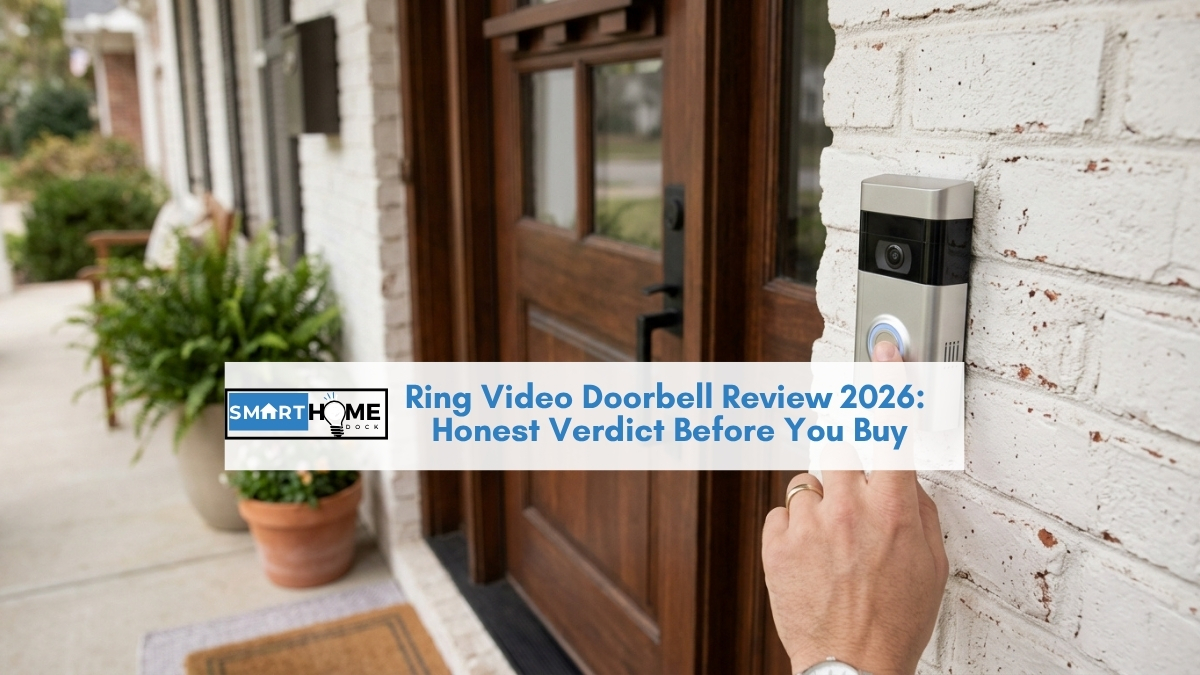
This article contains affiliate links. SmartHomeDock earns a small commission if you buy through them, at no extra cost to you.
This Ring video doorbell review starts where most others don’t: with the subscription. Ring practically invented the video doorbell category.
Consequently, it has held the largest market share in North America since before Amazon acquired it in 2018.
The hardware is genuinely polished, the app is well-designed, and Alexa integration is the deepest of any doorbell brand available.
Three things complicate the Ring video doorbell review in 2026, and all three belong at the top rather than buried in footnotes.
First, the subscription situation: a Ring doorbell without a paid plan is a live-view intercom, not a security camera.
Second, the privacy track record: Mozilla Foundation’s 2026 review describes Ring as one of the most privacy-hostile products they have reviewed.
Third, the competition has caught up: eufy delivers comparable hardware with local storage and no subscription, and Google Nest offers a polished alternative for Apple and Google ecosystem users.
This review covers all three honestly, before any product recommendation.
Quick Answer: Ring Doorbell Review 2026
Is Ring worth it? Yes, for Alexa households that accept a subscription and are comfortable with cloud-dependent architecture. Ring’s Alexa integration is the best in the category. The app is excellent. Setup is simple. The hardware is reliable.
Not worth it if: you use Apple HomeKit (Ring has no HomeKit support), you want local storage (Ring has none), or ongoing subscription costs are a concern. At $4.99 per month for one camera, a Ring doorbell costs $60 per year indefinitely on top of the hardware price.
Best Ring doorbell for most buyers: Ring Doorbell Plus (~$180): 1536p resolution, head-to-toe field of view, battery-powered, no wiring needed. See our best Ring doorbell guide for the full model comparison.
Ring Video Doorbell Subscription: The Most Important Section in This Review
Most Ring doorbell reviews bury the subscription in section four or five. It belongs first, because it changes the fundamental nature of what you are buying.
Without any Ring Home subscription, a Ring doorbell gives you: live view (see who is at the door in real time), two-way audio (speak to visitors), and motion alerts (a notification when motion is detected).
What it does not give you: recorded clips, saved video history, or any way to review footage after the moment has passed.
If a package is stolen while you are at work, you receive a motion alert but no clip. There is nothing to review. There is nothing to share with the police.
This matters more than most buyers expect until the moment it matters.
Ring Home subscription plans in 2026
| Plan | Price | Devices covered | What it adds |
|---|---|---|---|
| No subscription | $0 | All | Live view, two-way audio, motion alerts. No recorded clips. |
| Ring Home Basic | $4.99/month | 1 device | 180-day video history, clip saving, snapshot capture, smart alerts (person, package, vehicle) |
| Ring Home Standard | $9.99/month | All devices at one address | Everything in Basic, covers unlimited Ring devices. Right choice for 2+ cameras. |
| Ring Home Pro | $19.99/month | All devices + alarm | 24/7 professional monitoring, cellular backup, Alexa Guard Plus, facial recognition |
Consequently, most single-doorbell households choose Ring Home Basic at $4.99 per month, which adds up to $60 per year on top of the hardware cost.
Over three years, a Ring Doorbell Plus at $180 plus Basic plan costs $360 total. A comparable eufy doorbell with no subscription costs $170 upfront and nothing thereafter.
The subscription is worth paying if you value Ring’s Alexa integration, its established ecosystem, and its app quality. It is not worth paying if those specific advantages do not matter to your use case.
Note on Ring Home naming
Ring rebranded its subscription plans from “Ring Protect” to “Ring Home” in 2025. Any review still referring to Ring Protect Plus or Ring Protect Pro is describing the same plans under the old names. The pricing changed alongside the rebrand. If you see older pricing figures (Ring Protect Basic at $3.99 or $10/month for Protect Plus), those are outdated. Current 2026 pricing is Basic at $4.99, Standard at $9.99, Pro at $19.99 per month.
How Does a Ring Video Doorbell Work?
A Ring doorbell replaces the button on your door frame with a camera-equipped device.
When someone presses the button or walks into the motion detection zone, the doorbell sends an alert to your phone via the Ring app.
You can open the app, see a live video feed of whoever is at the door, and speak to them through the two-way speaker and microphone, whether you are inside the house or across the country.
Specifically, the camera streams video to Ring’s cloud servers in real time. With a Ring Home subscription, motion events are recorded as clips and stored for up to 180 days.
Without a subscription, footage is not saved anywhere. There is no local storage option on any current Ring doorbell model.
Notably, connectivity is Wi-Fi only on battery and standard wired models. The Ring Doorbell Elite uses Power over Ethernet (PoE), which provides continuous power through the network cable and eliminates both battery charging and Wi-Fi dependency.
All Ring doorbells require the Ring app on iOS or Android for setup and daily use.
Notably, Ring works without a chime if you prefer to receive alerts on your phone only.
Ring also sells a plug-in Ring Chime (~$30) that sounds a traditional doorbell tone inside the home when the button is pressed, and a Ring Chime Pro (~$50) that extends Wi-Fi coverage alongside the chime function.
Ring Doorbell Models in 2026: Which One You Are Actually Choosing Between
| Model | Price | Power | Resolution | FOV | Right for |
|---|---|---|---|---|---|
| Ring Wired Doorbell | ~$80 | Wired only | 1080p | 155° | Budget entry, existing doorbell wiring |
| Ring Battery Doorbell (2nd gen) | ~$100 | Battery | 1080p | 155° | Renters, no existing wiring |
| Ring Doorbell Plus | ~$180 | Battery | 1536p | 150° + head-to-toe | Best for most buyers: higher res, full person view |
| Ring Doorbell Pro 2 | ~$250 | Wired only | 1536p | 150° + head-to-toe | Best wired model, 3D motion detection |
| Ring Doorbell Elite | ~$500 | PoE | 1080p+ | 155° | Commercial and multi-unit property use |
For individual model verdicts and a head-to-head comparison across all five, see our dedicated best Ring doorbell guide.
This review focuses on Ring as a brand: the question of whether Ring is the right choice before the question of which Ring model.
Ring Doorbell and Alexa: The Strongest Integration in the Category
Ring is Amazon-owned, which means its Alexa integration is the deepest available in any doorbell brand.
This is Ring’s clearest competitive advantage in 2026 and the primary reason to choose it over eufy or Nest for Alexa households.
Specifically, what Ring-Alexa integration delivers that competitors cannot match: when someone presses the Ring doorbell, Echo Show displays with screens automatically show the live camera feed without any voice command needed.
You see the visitor on your kitchen display before you decide whether to speak to them. “Alexa, show the front door” pulls up the live feed on any Echo Show device on demand.
“Alexa, answer the front door” activates two-way audio from the Echo device. Motion alerts from Ring can trigger Alexa Routines.
The doorbell detecting motion at sunset can automatically turn on outdoor lights through any Alexa-compatible smart bulbs or switches.
Furthermore, Ring Alarm integration means a Ring doorbell press can trigger a Ring Alarm disarm sequence when your phone is nearby, and arm the alarm when you leave.
For households already in the Ring ecosystem, the doorbell becomes a control point for the broader security setup, not just a standalone camera.
Furthermore, Google Assistant integration exists but is less deep. Apple HomeKit is not supported on any Ring product.
For iPhone users who want a doorbell in Apple Home with Siri control and HomeKit Secure Video, eufy or Logitech Circle View are the correct alternatives.
Ring Doorbell Installation: What to Expect
Notably, battery Ring doorbells (Ring Battery Doorbell 2nd gen, Doorbell Plus) install without any existing wiring.
The included bracket mounts to the door frame with two screws. The doorbell snaps into the bracket.
Setup in the Ring app takes approximately five minutes via QR code scan. This is the correct starting point for renters, apartment dwellers, or any property without existing doorbell wiring.
Furthermore, wired Ring doorbells (Wired Doorbell, Pro 2) require an existing doorbell button with 8 to 24V AC transformer wiring.
The installation process: turn off power at the breaker, remove the existing doorbell button, connect the two low-voltage wires to the Ring terminals (polarity does not matter on most models), mount the bracket to the wall using the built-in level, snap the doorbell into position, restore power, and complete app setup.
Most wired installs take 20 to 30 minutes. No electrician is required for standard doorbell wiring replacement.
The Ring Doorbell Elite requires Power over Ethernet infrastructure: a PoE switch or injector and an Ethernet cable run to the door frame.
This is a professional installation for commercial or multi-unit properties. It is not a DIY project for most homeowners.
Eight years of Ring installations: the one check that saves most headaches
Before buying a wired Ring doorbell, confirm your existing doorbell transformer outputs at least 8V AC. Some older homes have 6V transformers that are insufficient for Ring’s electronics. Checking this before purchase costs nothing: unscrew the existing doorbell button, look at the two wires, and check the transformer rating (usually located near the main electrical panel or inside a utility closet). If it reads 6V, buy a battery Ring model or replace the transformer before installation.
Additionally, check whether your existing indoor chime is a mechanical chime or a digital chime. Ring includes a resistor (pro power kit) for mechanical chimes that prevents buzzing. Digital chimes are often incompatible with wired Ring doorbells without additional configuration. The Ring compatibility tool at ring.com/compatibility confirms this before purchase.
Ring Doorbell Privacy: The Honest Assessment
This is the section most Ring-affiliated review sites either skip or minimise. SmartHomeDock has no relationship with Ring, so here is the complete picture.
The Mozilla Foundation’s 2026 privacy review of the Ring Doorbell Pro Gen 3 describes it as one of the most privacy-hostile products they have reviewed. The specific findings:
No offline mode and no local storage. Every Ring doorbell processes all footage through Ring’s cloud infrastructure. If Ring’s servers go down, recording stops. There is no option to store footage locally on a card or home server. This is a fundamental architectural choice, not a missing feature. Ring is cloud-dependent by design.
Documented history of unauthorised access. Ring has acknowledged that employees accessed customer footage without consent in the past. Ring has also shared video with law enforcement without a warrant on documented occasions. Ring ended its Request for Assistance programme (the direct police portal for requesting Ring footage) in 2024. As of 2026, police must serve a warrant or obtain explicit user consent for Ring footage. This is a meaningful policy improvement over the pre-2024 situation, though the underlying cloud-dependent architecture remains unchanged.
The E2EE trade-off. Ring offers end-to-end encryption as an optional setting. Enabling it makes your recordings genuinely private: Ring cannot access them. However, enabling E2EE disables shared user accounts, person detection, facial recognition, 24/7 recording, pre-roll recording, and AI-powered video search. You are choosing between privacy and most of Ring’s advanced features. Most buyers who enable E2EE effectively have a more expensive basic camera.
The practical risk context. Ring processes thousands of law enforcement requests annually. For buyers who are not concerned about this (the majority of Ring’s large customer base), the service functions as advertised and the privacy trade-off is acceptable. For buyers who are concerned: eufy’s HomeBase architecture stores footage locally with no mandatory cloud upload, and no footage leaves your home without your explicit choice to share it. This is a fundamentally different privacy architecture.
Ring Doorbell Pros and Cons: Is the Ring Doorbell Worth It in 2026?
| Pros | Cons |
|---|---|
| Deepest Alexa integration of any doorbell brand: auto-displays on Echo Show, voice-triggered two-way audio | No Apple HomeKit support: iPhone users cannot add Ring to Apple Home |
| Polished app, simple setup: QR code scan to working doorbell in under five minutes | No local storage on any model: 100% cloud dependent |
| Large established ecosystem: doorbells, cameras, alarms, smart lighting all in one app | Subscription required for recorded video: without it, Ring is a live-view intercom only |
| Battery models work without any existing wiring: correct choice for renters | Privacy concerns: documented history of employee access and law enforcement data sharing |
| 180-day video history on all Ring Home plans: longest standard retention in the category | Battery life 6 to 12 months depending on traffic: needs periodic recharging |
| Ring Alarm integration: doorbell connects to Ring’s broader security system | Ongoing subscription cost accumulates: $60 to $240 per year depending on plan |
Ring Doorbell vs Nest vs eufy: Which Brand Is Actually Right for You
| Factor | Ring | Google Nest | eufy |
|---|---|---|---|
| Best ecosystem | Alexa (best) | Google Home (best) | HomeKit (best), Alexa, Google |
| Apple HomeKit | ❌ | ❌ | ✅ HomeKit Secure Video |
| Local storage | ❌ Cloud only | ❌ Cloud only | ✅ HomeBase local storage |
| Subscription required for video | ✅ Yes ($4.99/mo+) | ✅ Yes ($8/mo+ for Nest Aware) | ❌ Local storage free |
| 3-year total cost (doorbell + plan) | ~$360 (hardware + Basic) | ~$530 (hardware + Aware) | ~$170 (hardware only) |
| App quality | ✅ Excellent | ✅ Excellent | ✅ Good |
| Privacy architecture | ⚠️ Cloud-only, documented concerns | ⚠️ Cloud-only, Google account | ✅ Local-first, no mandatory cloud |
| Battery life (wireless models) | 6 to 12 months | 3 to 6 months (wired typical) | Up to 180 days |
Consequently, the honest verdict on Ring vs the competition: Ring wins for Alexa households who accept cloud dependency and a subscription.
eufy wins for privacy-conscious buyers, Apple HomeKit users, and anyone who wants no ongoing cost. Google Nest wins for Google Home households who want the tightest Google integration.
None of the three is universally the best. The correct choice depends entirely on which ecosystem the buyer is already in.
Frequently Asked Questions: Ring Video Doorbell Review 2026
Is the Ring doorbell worth it in 2026?
Yes, for Alexa households that accept a subscription: and the ring doorbell review conclusion from eight years of testing is that Ring delivers the best Alexa-ecosystem doorbell available: auto-display on Echo Show, voice-triggered two-way audio, and Ring Alarm integration for households with a Ring security system.
The honest caveat: without a Ring Home subscription starting at $4.99 per month, Ring is a live-view intercom without recorded video.
If you use Apple HomeKit, Ring is not compatible. If ongoing subscription costs are a concern, eufy delivers comparable hardware with free local storage and no monthly fee.
Can You Use a Ring Doorbell Without a Subscription? The Honest Ring Doorbell Review Answer
Yes, but with significant limitations. A Ring doorbell without subscription provides live view, two-way audio, and motion alerts.
It does not save or record any video. If a motion event occurs and you do not check the app in real time, there is no footage to review afterward.
For most security use cases, this makes the subscription functionally necessary rather than optional.
The Ring Home Basic plan at $4.99 per month adds 180-day video history and smart person, package, and vehicle detection alerts.
Does Ring work with Alexa?
Yes, and Ring’s Alexa integration is the deepest of any doorbell brand.
When someone presses the Ring doorbell with Alexa, Echo Show displays automatically show the live camera feed without a voice command.
“Alexa, show the front door” works on any Echo Show device. “Alexa, answer the front door” activates two-way audio.
Motion detection can trigger Alexa Routines, connecting the doorbell to smart lighting and other devices.
This native integration is Ring’s strongest competitive advantage over eufy and Nest for Alexa households.
Does Ring work with Apple HomeKit?
No, ring does not support Apple HomeKit on any current model.
Ring cameras and doorbells do not appear in the Apple Home app and do not support HomeKit Secure Video or Siri camera commands.
For iPhone users who want a doorbell that integrates with Apple Home, the eufy Video Doorbell S340 (HomeKit Secure Video) or Logitech Circle View Doorbell are the correct alternatives.
This is one of Ring’s most significant limitations for Apple ecosystem households.
Is Ring doorbell privacy a concern?
It is a legitimate concern that each buyer should evaluate honestly. Ring has no local storage option.
All footage is processed through Ring’s cloud infrastructure.
The Mozilla Foundation’s 2026 review describes Ring as one of the most privacy-hostile products they have tested.
Ring has a documented history of employee footage access and law enforcement data sharing.
Ring ended its direct police portal in 2024 and now requires a warrant or explicit user consent for footage requests, which is a meaningful improvement.
Additionally, Ring offers end-to-end encryption that makes footage genuinely private, but enabling it disables most of Ring’s advanced features including person detection, facial recognition, and pre-roll recording.
Buyers who prioritise privacy should consider eufy’s local-storage architecture instead.
Final Verdict: Ring Video Doorbell Review 2026
For Alexa households that accept a subscription, the Ring Doorbell Plus (~$180) is the right choice: 1536p resolution, head-to-toe field of view, battery-powered installation without wiring, and the deepest Echo integration available in any doorbell category. Privacy-conscious buyers and anyone wanting no ongoing cost will find the eufy Video Doorbell S330 (~$170 with local storage, no subscription) a better total value over any ownership period longer than a year. Apple HomeKit users should not buy Ring at all. It has no HomeKit support and no announced plans to add it.
