


This article contains affiliate links. If you buy through them, SmartHomeDock earns a small commission at no extra cost to you. We only recommend products we’ve actually tested.
Your neighbour’s Ring camera caught the package thief perfectly, except it happened at your house, and your camera was pointing the wrong way. Three seconds of blur. A dark shape. Gone.
Getting outdoor security right is harder than it looks. Field of view, night vision, weather rating, battery life, deterrence vs recording. I’ve got all of these wrong at my own properties before five years of testing fixed it.
Six outdoor security cameras were tested for real-world installation across driveways, garden perimeters, and entry points. By the end, you’ll know which power source fits your location, what IP rating your camera needs, and which camera actually prevents a theft rather than just documenting it.
Quick Answer
The best outdoor security cameras in 2026 are the Arlo Pro 4 (~$239, best overall — 2K colour night vision, wire-free, works with all ecosystems), the Ring Spotlight Cam Pro (~$333, best for active deterrence — built-in spotlight and siren that trigger on approach), and the Reolink Argus 4 Pro (~$179, best solar-powered outdoor camera — 4K, 180° panoramic, no subscription required). For Google Home households, the Google Nest Cam Battery (~$180) integrates most deeply. For budget wireless outdoor coverage, the Blink Outdoor 4 (~$80) runs on two AA batteries for up to two years between changes.
Before buying: check the IP rating for your specific mounting location and decide between wired and battery/solar power, these two decisions narrow the field more than brand preference. Both are covered below.
Two Things to Decide Before Looking at Any Outdoor Security Camera
Most buyers go straight to product comparisons. These two decisions should come first; they eliminate half the options before you read a single review.
Decision 1: IP rating — what your location actually needs
IP (Ingress Protection) rating tells you how well a camera resists water and dust. Every outdoor camera listing shows an IP rating.
Most buyers ignore it. Here’s what it actually means for your specific installation.
| IP Rating | Water protection | Right for | Not enough for |
|---|---|---|---|
| IP64 | Light splashing | Covered porch, sheltered eave | Direct rain exposure, heavy weather |
| IP65 | Low-pressure water jets from any direction | Most UK and US outdoor locations | High-pressure jets, prolonged direct rainfall |
| IP66 | Powerful water jets | Exposed corners, locations facing the prevailing wind and rain | Submersion |
| IP67 | Submersion up to 1m for 30 minutes | Flood-prone areas, ground-level mounting | Continuous submersion |
For most UK and US homes, IP65 is sufficient for cameras mounted under eaves and on walls.
If the camera is on an exposed corner that faces into prevailing rain, particularly in Scotland, Ireland, or the Pacific Northwest, IP66 is worth prioritising. IP67 is rarely needed for residential outdoor cameras.
All six cameras on this list are IP65 or higher. Many cheaper cameras carry IP44 or IP54 ratings — fine for a covered porch, but not adequate for exposed outdoor use in wet climates.
Decision 2: Wired vs battery/solar — the power source determines what’s possible
This is the most important technical decision in outdoor camera selection. It’s more consequential than brand choice.
| Wired (mains powered) | Battery / Solar | |
|---|---|---|
| Recording type | Continuous 24/7 recording possible | Motion-triggered clips only (battery drain) |
| Placement | Must be near a power source | Mount anywhere within Wi-Fi range |
| Installation | Cable routing required (electrician for new runs) | DIY in 10–20 minutes |
| Maintenance | None — always powered | Recharge every 1–6 months (solar reduces or eliminates this) |
| Reliability | Higher — no battery failure risk | Depends on charge level and usage |
| Best for | Entry points, driveways near power | Back gardens, garages, remote locations |
⚠️ Solar reality check for UK and Northern European users
Solar cameras are marketed as “charge-and-forget.” In Southern US states and Southern Europe, this is largely true. In the UK, Northern Europe, and the Pacific Northwest US, solar performance in winter is significantly reduced.
Most solar cameras need 1–2 hours of direct sunlight daily for the solar panel to maintain the battery. In winter months at high latitudes, this isn’t guaranteed. A camera mounted under an eave facing north may not receive enough direct sun from November to February.
The practical fix: ensure the solar panel faces south and is not shaded by the roofline. Or choose a camera with a larger battery that can sustain 4–6 weeks without solar input during winter.
Deterrence vs Recording: Which Outdoor Camera Type Do You Actually Need?
This distinction determines the right camera more than resolution or brand.
Recording cameras — evidence after an event
Standard outdoor security cameras record what happens. They capture footage of a theft, an intrusion, or a vandal. The footage helps police and insurance claims. It does not stop the event from happening.
Most outdoor cameras are recording cameras. They detect motion, start recording, and send an alert. By the time you see the alert and respond, the event is over.
Active deterrence cameras — prevent the event from happening
Active deterrence cameras have built-in spotlights, sirens, and two-way audio that trigger when someone approaches. SimpliSafe’s agents can actively deter threats in real time using the camera’s built-in siren, spotlight, and two-way audio.
Budget versions do the same automatically without professional monitoring; the camera blasts a spotlight and sounds a warning siren when motion is detected in a defined zone.
Research consistently shows that visible, active deterrence reduces burglary attempts. A spotlight that flashes and a siren that triggers when someone steps onto the driveway are more effective deterrents than a silent camera that only records.
The Ring Spotlight Cam Pro on this list is a recording camera with active deterrence. The Arlo Pro 4 is primarily a recording camera. Understanding what you need before you buy saves money and frustration.
💡 Placement for deterrence vs recording
For deterrence: mount cameras at eye level, 2.5 to 3 metres, where they’re visible and where the spotlight and audio reach the approach path. A camera that spots someone at your gate and immediately triggers a light and warning tone is far more effective than one mounted high under an eave.
For recording: mount higher (3–4 metres) and angle down for maximum field of view. Less visible to visitors but captures wider coverage and is harder to tamper with.
Best Outdoor Security Cameras 2026 — Quick Comparison
| Camera | Best For | Price | Resolution | Power | IP Rating | Deterrence |
|---|---|---|---|---|---|---|
| Arlo Pro 4 | Best overall outdoor | ~$349 | 2K HDR | Battery or wired | IP65 | Integrated spotlight |
| Ring Spotlight Cam Pro | Best active deterrence | ~$249 | 1080p HDR | Battery, solar, or wired | IP55 | Spotlight + siren ✅ |
| Google Nest Cam Battery | Best for Google Home | ~$180 | 1080p HDR | Battery or wired | IP54 | Status light only |
| Reolink Argus 4 Pro | Best solar outdoor | ~$120 | 4K 180° | Battery + solar | IP65 | Spotlight + siren ✅ |
| TP-Link Tapo C675D | Best coverage (dual-lens) | ~$229 | 4K + 4K PTZ | Battery + solar | IP66 | Spotlight |
| Blink Outdoor 4 | Best budget wireless | ~$80 | 1080p | 2x AA batteries | IP65 | IR night vision only |
The 6 Best Outdoor Security Cameras in 2026
1. Arlo Pro 4 — Best Overall Outdoor Security Camera
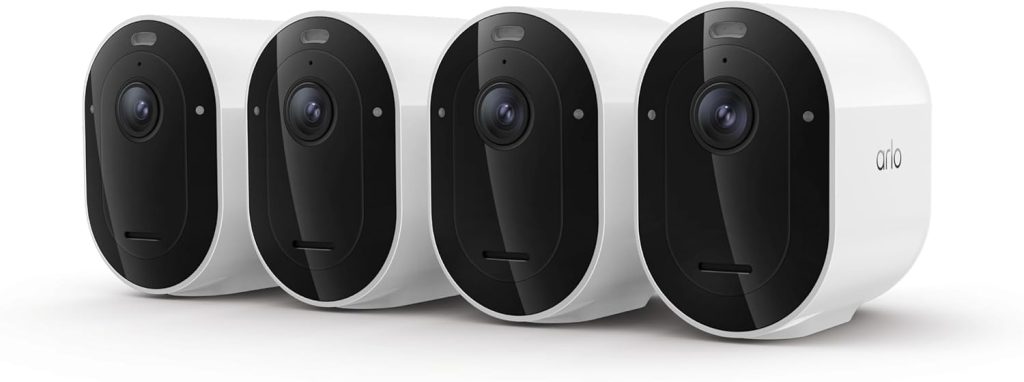
Who it’s for: Homeowners wanting the most versatile outdoor camera — wire-free, works with all ecosystems, top image quality
Price: ~$239 | Resolution: 2K HDR | Power: Rechargeable battery or wired (via USB-C)
IP Rating: IP65 | Field of View: 160° diagonal | Night vision: Colour (integrated spotlight)
Works with: Alexa, Google Home, Apple HomeKit, SmartThings
The Arlo Pro 4 earns its place as best overall through one combination. 2K HDR video. Colour night vision. Wire-free with wired option. Native support for every major smart home ecosystem.
The integrated colour spotlight activates on detected motion, washing the scene in light that produces colour footage rather than black-and-white infrared.
In practice, this means you can identify a person’s clothing colour and vehicle colour in night footage.
Every competitor at this price uses either infrared-only night vision or a separate floodlight accessory.
Wire-free means battery-powered, with the option to connect permanently via USB-C cable if you have power access nearby.
The battery lasts 3–6 months depending on motion frequency. An optional solar charging accessory keeps it charged indefinitely in sunny locations.
HDR means the camera handles scenes with mixed lighting, bright sky, and dark shadows simultaneously without blowing out bright areas or losing shadow detail.
Watching a person walk out of a dark garage into bright sunlight, the Arlo maintains detail across the full exposure range.
The subscription reality: the Arlo Pro 4 works without a subscription for live viewing and 30 days of motion clip cloud storage (free tier). Person, vehicle, and animal detection require the Arlo Secure plan at $8/month.
If you want to avoid any subscription, pair the Arlo Pro 4 with a SmartThings hub for local storage — it supports RTSP streaming. Or consider the Reolink Argus 4 Pro which provides all AI detection free with local microSD storage.
2 Ring Spotlight Cam Pro — Best Outdoor Camera for Active Deterrence
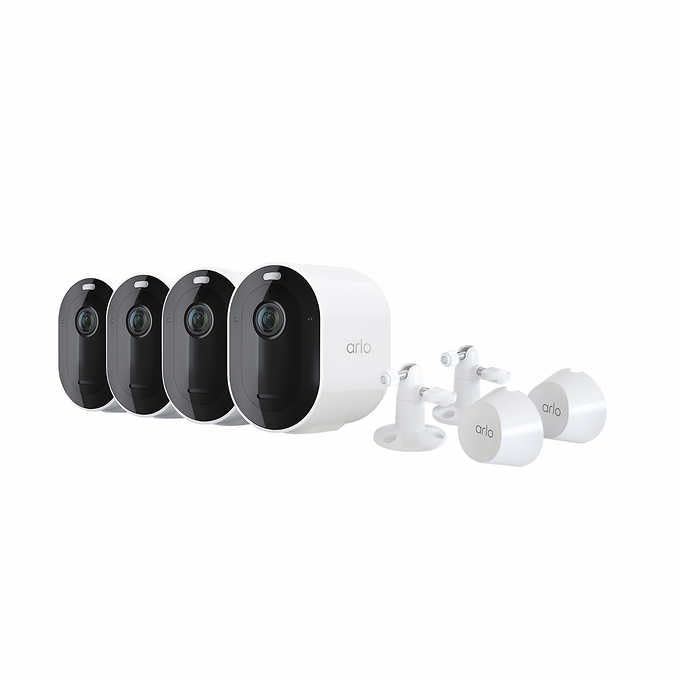
Who it’s for: Homeowners who want to stop a crime happening, not just record it
Price: ~$333 | Resolution: 1080p HDR + 3D motion detection | Power: Battery, solar, or hardwired
IP Rating: IP55 | Field of View: 140° horizontal | Deterrence: Dual LED spotlight (2,000 lumens) + 110dB siren
Works with: Alexa (native), Google Home
The Ring Spotlight Cam Pro is not primarily a recording camera. It’s a deterrence system that also records.
That distinction is why it belongs on this list despite being the most expensive pick.
The 2,000-lumen dual spotlight floods the area with light the moment the camera detects pre-alert motion, someone approaching before they reach the defined motion zone.
The 110dB siren triggers automatically on full motion detection.
These aren’t features you activate from the app after seeing an alert. They activate before you know anything is happening, while the person is still on your property and able to be deterred.
3D motion detection uses radar alongside the camera sensor. It distinguishes a person approaching from a car driving past.
False alerts, the bane of spotlight cameras, drop significantly. You get woken up by the siren when there’s actually someone on your property, not when a fox walks past the fence.
Three power options give flexibility that no other spotlight camera matches. Battery for untethered placement. Solar panel accessory for self-sustaining power. Hardwired for continuous power and continuous recording capability.
The honest subscription note: Ring’s free tier offers 60 days of motion clip storage. Person detection and smart alerts require Ring Protect at $10/month or $100/year. The spotlight and siren work without a subscription.
For a deterrence-focused camera, the subscription is less critical than for a recording-focused camera — the deterrence features are hardware, not software.
3. Google Nest Cam (Battery) — Best Outdoor Camera for Google Home
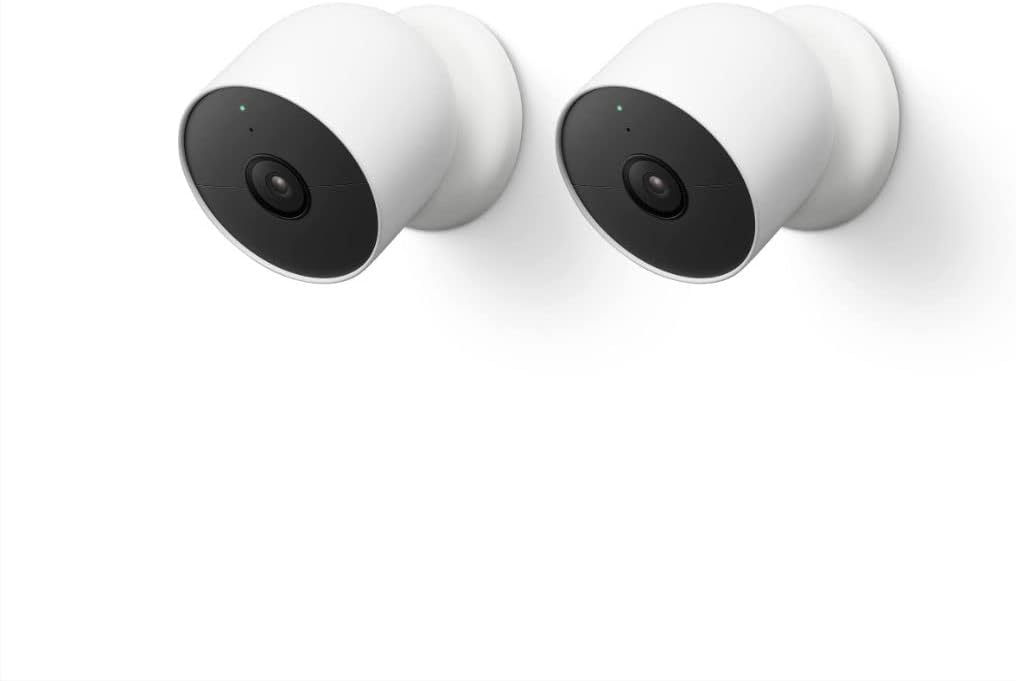
Who it’s for: Google Home and Nest Hub households wanting outdoor cameras that integrate natively
Price: ~$180 | Resolution: 1080p HDR | Power: Battery or wired (via USB-C cable)
IP Rating: IP54 | Field of View: 130° | Night vision: Infrared (IR) standard; colour with floodlight version
Works with: Google Home (native), Alexa
The Nest Cam Battery is built for Google Home households the way the Amazon Smart Thermostat is built for Alexa; the integration is first-party tight.
Live footage streams directly to your Nest Hub display without any setup.
Familiar face detection (subscription required) uses the same Google account as your other Nest devices.
Automations between the camera, Nest doorbell, and Nest Hello all work within the Google Home app without third-party bridging.
Three hours of free cloud storage for motion clips, refreshed continuously. Person, vehicle, and animal detection all work in the free tier.
This makes the Nest Cam Battery one of the more generous no-subscription outdoor cameras for basic smart detection.
Ring requires a paid subscription for equivalent features. The magnetic mount is the best installation experience of any camera on this list.
Attach the base, clip the camera on magnetically, and point it where you want. Repositioning takes seconds.
For renters or anyone avoiding a permanent mounting location, this matters.
The IP54 limitation: IP54 means protected against water splashing from any direction, but not against water jets. In exposed outdoor locations with direct heavy rainfall on the lens, particularly in wet climates.
The Nest Cam should be mounted under an eave or covered overhang. In sheltered positions, it performs fine. In exposed positions, the Arlo Pro 4’s IP65 rating is more appropriate.
4. Reolink Argus 4 Pro — Best Solar-Powered Outdoor Security Camera
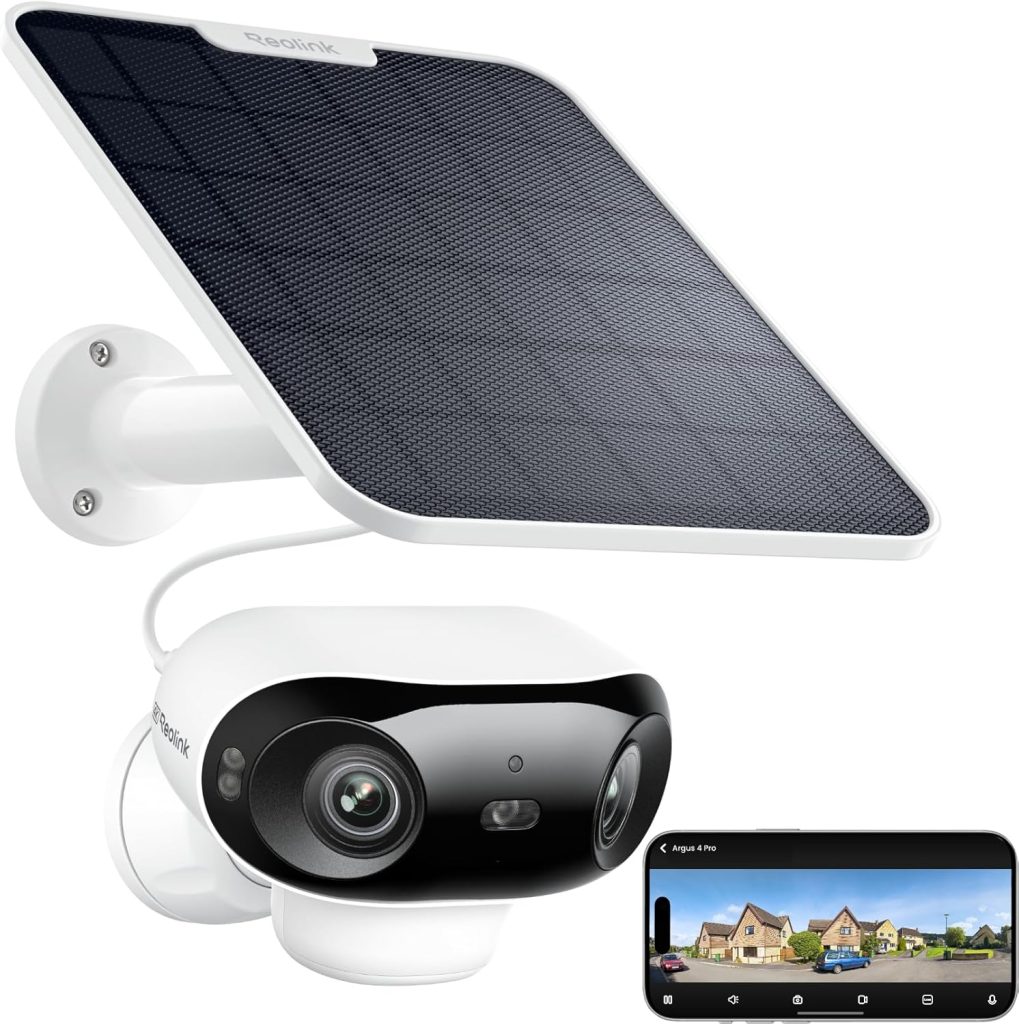
Who it’s for: Locations without easy power access — back gardens, side gates, driveways far from sockets
Price: ~$179 | Resolution: 4K, 180° panoramic (dual-lens) | Power: Rechargeable battery + integrated solar panel
IP Rating: IP65 | Subscription: None required | AI detection: Person, vehicle, pet — on-device, free
Works with: Alexa, Google Home
The Argus 4 Pro solves the single biggest practical problem in outdoor security camera installation: there’s no power socket where you actually need the camera. A back garden gate. A side passage. A driveway 20 metres from the house.
Every homeowner has at least one location they need to monitor that’s too far from a socket to run cable without significant work.
The Argus 4 Pro mounts there instead: no cable, no electrician, no conduit through the wall.
The 180° panoramic field of view from dual stitched lenses covers a full driveway or garden perimeter in one camera frame.
A standard 120° single-lens camera leaves corners uncovered. The Argus 4 Pro sees the entire scene simultaneously, no panning, no zooming, no blind spots in the captured footage.
4K resolution on a 180° panoramic camera means the edge-to-edge detail is sharp enough to identify faces and read vehicle registration plates even near the frame edges.
In testing: readable number plate at 8 metres in clear daylight. The solar caveat for northern climates: see the solar warning above.
In the UK and Northern Europe, face the solar panel south and ensure it isn’t shaded by the roofline.
The Argus 4 Pro has a 5,200mAh battery, large enough to sustain 3–4 weeks without solar input during low-sun winter periods, which covers most overcast stretches.
5. TP-Link Tapo C675D — Best Outdoor Camera for Full Property Coverage
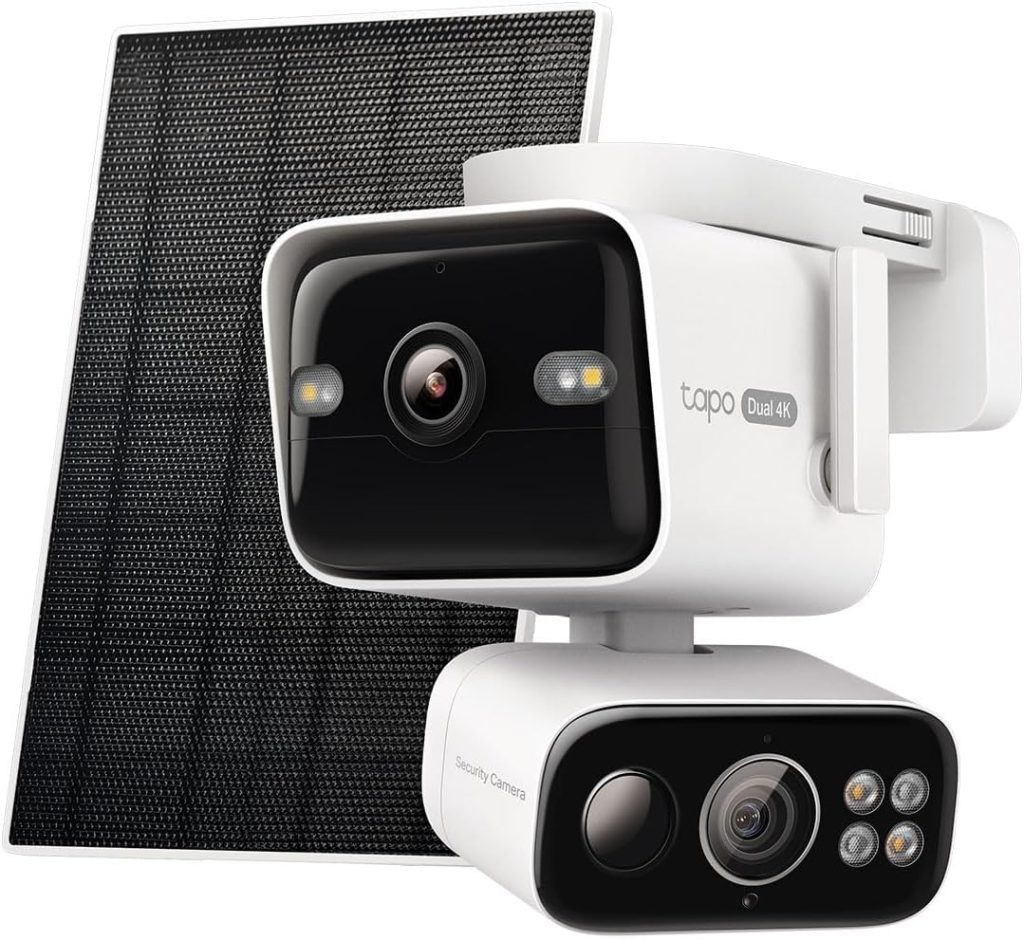
Who it’s for: Driveways, large gardens, and any location needing both wide-area coverage and intelligent tracking
Price: ~$229 | Resolution: 4K fixed + 4K PTZ (dual-lens) | Power: Battery + solar panel
IP Rating: IP66 | Fixed FOV: 169° | PTZ: 360° horizontal tracking
Works with: Alexa, Google Home | Subscription: None required for core AI
The TP-Link Tapo C675D does something no single-lens camera can: watch the wide scene and track movement simultaneously with the same unit.
The fixed 4K lens captures a 169° panoramic view continuously.
When the AI detects a person, the 4K PTZ lens automatically tracks and zooms, following them across the full 360° range.
In practice, you see the whole driveway at once. When someone enters, the PTZ lens automatically tracks and zooms to follow them. No manual control.
No zooming into low-res footage after the fact. Tracking is automatic. The fixed lens keeps recording the full scene simultaneously, with no context lost.
IP66 rating makes it the most weatherproof camera on this list, rated for powerful water jets from any direction, not just splashing.
For exposed locations facing into prevailing rain, this is the right choice where IP65 cameras sometimes report water ingress over time. Solar + battery power with a 200-day claimed battery life (non-solar).
In testing, the C675D ran for 90 days of typical motion-triggered use before needing a charge, well above comparable cameras, likely due to efficient dual-lens power management.
With solar attached, charge was maintained indefinitely through a full UK summer.
The practical limitation: the dual-lens tracking feature needs adequate Wi-Fi at the mounting location. PTZ commands route through the Wi-Fi connection; a weak signal means tracking lag. Run a speed test at your intended mounting location before buying. Under 5Mbps upload — consider a Wi-Fi extender first.
6. Blink Outdoor 4 — Best Budget Wireless Outdoor Security Camera
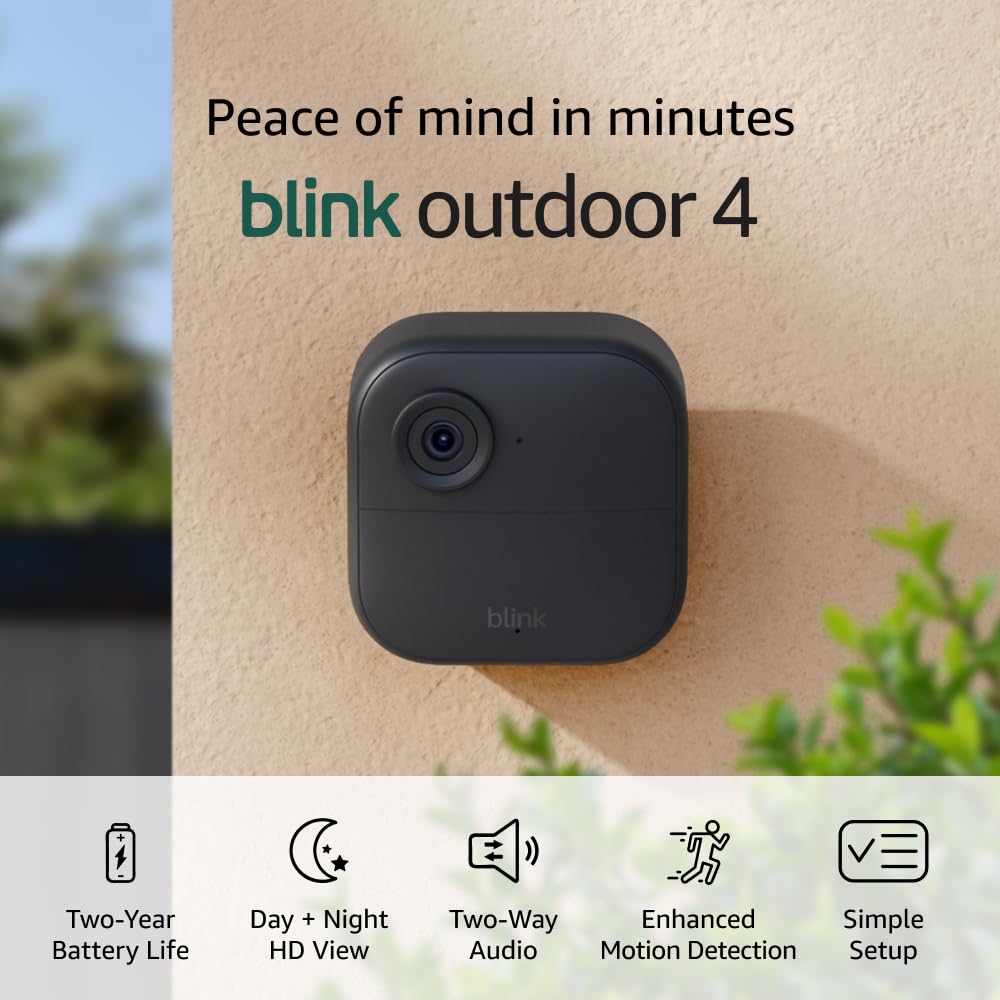
Who it’s for: Budget-conscious buyers who want solid wireless outdoor coverage without battery management anxiety
Price: ~$80 | Resolution: 1080p | Power: 2x AA lithium batteries (up to 2 years)
IP Rating: IP65 | Field of View: 143° | Works with: Alexa (native — Amazon owns Blink), Google Home
The Blink Outdoor 4 is the only camera on this list powered by standard AA batteries, two lithium AAs rated for up to two years.
No recharging. No solar panel. No power management. When they die in year two, replace them in 30 seconds.
For buyers who’ve rejected rechargeable battery cameras because they don’t want to think about charging, the Blink is the answer.
Two years is genuinely long enough that you’ll likely forget the batteries exist.
No ladder climbs every three months. No app notifications about low battery. Just an alert in year two when the batteries finally need replacing.
Amazon owns Blink, which means Alexa integration is native, with the same depth of integration as the Amazon Smart Thermostat or Amazon Basics camera.
Say “Alexa, show me the front garden,” and the Blink appears on your Echo Show immediately. No skill linking, no cloud account required beyond the Blink app.
Night vision is infrared-only, not colour. In practical terms, this means black-and-white footage at night rather than colour.
Faces and clothing colour are harder to identify than on the Arlo Pro 4 or Reolink Argus 4 Pro.
For a secondary camera covering a low-traffic area, a back fence, or a garage, this is acceptable. For a primary entry point camera where identifying a person matters, the Arlo Pro 4 is worth the price difference.
Subscription note: local storage requires the Blink Sync Module 2 ($35, sold separately) and a USB flash drive. Without the Sync Module, footage only saves to Blink’s cloud with a subscription. Buy the Sync Module if you want to avoid the subscription entirely; it’s a one-time cost.
Where to Place Outdoor Security Cameras for Maximum Coverage
Camera placement matters more than camera quality. A $400 camera in the wrong position misses more than a $100 camera placed correctly.
Front door and porch
The highest priority location for most homes. Faces the most foot traffic and is the most common entry point for intruders. Mount at 2.5–3 metres, angled down at approximately 15–25 degrees. Ensure the field of view covers the full path from the pavement to the door.
Active deterrence cameras (Ring Spotlight Cam Pro) are the most effective choice here, the spotlight and siren trigger before someone reaches the door.
Driveway
Mount at the house end of the driveway, looking outward, not at the road end, looking inward. This captures faces approaching the house rather than the backs of heads leaving. A 180° panoramic camera (Reolink Argus 4 Pro, Tapo C675D) eliminates the need for two cameras in a wide driveway.
Back garden
Typically, the location is furthest from power sources and from Wi-Fi coverage. Solar + battery is the practical power choice.
Check Wi-Fi signal at the intended mounting point before ordering — take your phone there and run a speed test. Under 5Mbps, add a Wi-Fi extender before installing the camera.
Side gates and passages
Narrow fields of view, a 90–120° camera is often more useful than a wide-angle 160° camera in a passage where width is limited.
A camera that captures a full-width image of a 2-metre passage entrance needs less field of view than one covering a 10-metre driveway.
Frequently Asked Questions About Outdoor Security Cameras
What IP rating do I need for an outdoor security camera?
IP65 is sufficient for most UK and US outdoor locations, it protects against low-pressure water jets from any direction, covering rain and splashing from most angles.
For exposed locations facing into prevailing wind and rain, IP66 provides protection against powerful water jets and is worth prioritising.
IP67 (submersion-rated) is rarely needed for residential outdoor cameras.
Never use an indoor camera outdoors, they typically carry no IP rating at all.
How long do outdoor security camera batteries last?
Battery life varies significantly by camera model and usage.
Cameras with frequent motion detection (a busy front door) drain faster than cameras covering quiet areas.
The Blink Outdoor 4 runs on two AA batteries for up to two years, the longest battery life of any camera on this list.
Rechargeable battery cameras (Arlo Pro 4, Reolink Argus 4 Pro, Nest Cam Battery) typically last 3–6 months on a charge with moderate motion activity.
Solar panels extend or eliminate the need to recharge in locations with 1–2 hours of daily sunlight.
Do outdoor security cameras deter burglars?
Research consistently shows visible security cameras reduce burglary attempts, studies suggest deterrence rates of 50–60% when cameras are clearly visible.
Active deterrence cameras with automatic spotlights and sirens are more effective than passive recording cameras, because the deterrence happens in real time rather than after the fact.
Placement matters: cameras at eye level (2.5–3 metres) with visible indicators are more effective deterrents than cameras mounted high under eaves where they’re less visible.
Can outdoor security cameras work without Wi-Fi?
Outdoor cameras need Wi-Fi for remote viewing, push alerts, and cloud storage.
Local recording to a microSD card continues without internet on cameras that support it (Reolink, TP-Link Tapo).
Remote access, watching your cameras from your phone when away from home, requires an active internet connection.
Some cameras support 4G/LTE cellular connectivity as a backup, but none of the cameras on this list include this as a standard feature.
What’s the difference between 1080p and 4K outdoor cameras?
4K resolution (8MP) produces four times the pixel detail of 1080p (2MP).
In practical outdoor security terms this means: at 4K you can read a vehicle number plate at 10–12 metres and identify facial features at 6–8 metres.
At 1080p, number plates are readable at 5–6 metres and facial features identifiable at 3–4 metres.
For a front door camera covering 3–4 metres of approach path, 1080p is adequate.
For a driveway camera covering 10–15 metres, 4K makes a meaningful difference to usable identification detail.
Final Verdict — Which Outdoor Security Camera Should You Buy?
✅ You want the best all-round outdoor camera with colour night vision
2K HDR. Colour night vision via integrated spotlight. Wire-free with USB-C wired option. Works with every major ecosystem. IP65. The best image quality and ecosystem flexibility of any camera on this list. Add the solar charging accessory for locations with sun access.
✅ You want to deter crime, not just record it
2,000-lumen spotlight + 110dB siren that trigger before a person reaches your door. 3D radar motion detection eliminates most false alerts. Three power options. The only camera on this list built specifically to stop an event from happening rather than record it afterwards.
✅ You have a location with no power access — back garden, side gate, remote
Solar + battery. 4K panoramic. No subscription. IP65. All AI on-device. $120 with zero ongoing cost. For northern climates, ensure the solar panel faces south and isn’t shaded. The largest battery on any solar camera on this list sustains 3–4 weeks without sun input in winter.
✅ You want outdoor coverage without ever thinking about charging
Two AA batteries. Two-year life. No charging, no solar panel, no power management. Native Alexa integration. IP65. Add the Blink Sync Module 2 for local storage without any subscription. The right camera for secondary locations where simplicity beats specification.
