


You want smart lighting. You go to buy it and hit the question nobody warned you about: smart bulbs or smart switches? Buy the wrong one, and you’ll spend the next six months fighting it.
A partner who keeps flipping the physical switch. A ceiling rose with six sockets, where smart bulbs cost more than the fitting itself.
I’ve set up both across a dozen homes. The smart bulbs vs smart switches decision is genuinely different depending on your wiring, your household, and how many bulbs are in each fixture.
This guide decides for you. Not “it depends,” a clear answer for each specific situation. And one update that changes the calculation in 2026 that no other guide covers.
Quick Answer: Smart Bulbs vs Smart Switches
Buy smart bulbs if: you rent, you want colour, you have table lamps, or you want to start without any installation work. Smart bulbs are also the only option for fixtures not controlled by a wall switch.
Buy smart switches if: you own your home, you have ceiling fixtures with 3+ bulbs on one switch, or you want a setup the whole household uses including people who never touch the app.
Buy both: smart switches for overhead ceiling fixtures, smart bulbs for lamps and accent lighting. Most permanent smart home setups end up here and it’s cheaper per room than going all-bulb.
Smart Bulbs vs Smart Switches: The Core Difference
The technical definitions are simple. The practical implications are not.
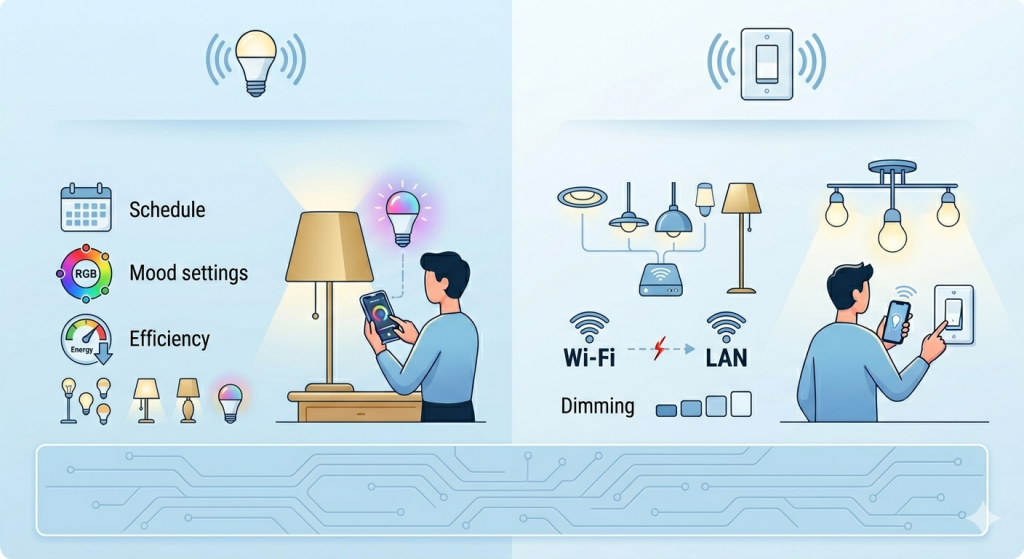
Smart bulbs put the intelligence inside the light source. They need constant power to maintain their wireless connection. Turn off the wall switch, and the bulb loses power; it can’t respond to voice commands or app control until someone flips the switch back on.
Smart switches put the intelligence at the power control point. The switch stays powered and connected to the network regardless of the bulb’s state. The bulb in the socket doesn’t need to be smart; any standard LED works. The physical switch still functions for anyone who prefers it.
That difference determines the right answer in the smart bulbs vs smart switches debate far more than any spec comparison does.
The Problem Both Options Have: But in Opposite Ways
This is the thing nobody tells you before you buy. The physical switch problem affects smart bulbs and smart switches differently and the fix for each is completely different.
The smart bulb problem: one switch flip kills everything
Someone flips the wall switch off. The smart bulb loses power. All voice control, app control, and automation stop working. The bulb is now a standard dumb bulb until someone turns the switch back on.
This happens constantly in shared homes. A partner, a cleaner, a guest, anyone who hasn’t been told: “Leave the switch alone.” The technical fix is to tape over switches or fit switch guards. The real fix is to accept that this whole decision comes down to whether your household will leave the switches alone.
The smart switch problem: one switch, no individual control
A smart switch controls the circuit. All bulbs on that circuit turn on together, dim together, and turn off together. You cannot set the left bulb to warm white and the right bulb to cool white.
You cannot address individual sockets. For uniform control of a whole room, this is fine. For per-bulb colour or brightness control, you need smart bulbs in those sockets.
The fixes
For smart bulbs: fit switch guard covers over wall switches to prevent accidental switching. Or use Lutron Caséta smart switches, which are specifically designed to keep smart bulbs powered even in the “off” position, which solves the problem at the source. See our best smart light switches guide for full details.
For smart switches: use them on circuits where uniform control is fine. Use smart bulbs in fixtures where you want individual control per socket particularly lamps not connected to a wall switch at all.
💡 How I run my own home: eight years of testing both
Smart switches on every overhead ceiling fixture. The physical switch still works normally. Nobody in the house has to change how they use a light switch. Automations run on top of the physical switch without conflicting with it.
Smart bulbs in every table lamp, bedside light, and floor lamp. These aren’t connected to wall switches, so the physical switch problem doesn’t apply. Full colour and individual brightness control where it matters.
How Matter Changed the Smart Bulbs vs Smart Switches Decision in 2026
This update changes the calculation meaningfully.
Before Matter, ecosystem compatibility was a strong argument for smart bulbs.
Bulbs from Philips Hue, LIFX, and Govee worked natively with Alexa, Google Home, and HomeKit simultaneously.
Many smart switches were ecosystem-specific a Lutron switch worked with Alexa, but needed extra steps for HomeKit.
Matter ended that. Matter-certified smart switches and smart bulbs both work natively across Alexa, Google Home, and Apple HomeKit via a single QR code scan.
The ecosystem flexibility argument for choosing bulbs over switches has largely disappeared in 2026 for anyone buying new hardware.
Check whether the switch you’re considering is Matter-certified. Ecosystem compatibility was a real argument for bulbs before Matter. It largely isn’t anymore.
The Kasa KS220, Aqara Smart Wall Switch, and Nanoleaf Essentials Lightstrip all support Matter. A Matter-certified switch joins your Apple Home app the same way a Matter-certified bulb does.
The remaining genuine arguments for bulbs over switches are colour capability, per-socket individual control, and renter portability. Those haven’t changed.
Smart Bulbs vs Smart Switches: The Decision by Situation
Stop at the scenario that matches your home.
You’re renting
Smart bulbs. No question. Smart switches require opening the wall switch box and touching wiring, most tenancy agreements prohibit this. Smart bulbs screw into existing sockets, leave no marks, and come with you when you move. For renters, the debate isn’t a debate at all.
You have a ceiling fixture with 3 or more bulbs on one switch
Smart switch. One $20–$25 switch controls all bulbs simultaneously. Equipping three sockets with smart bulbs costs $36–$75, depending on brand. Six sockets cost $72–$150. The switch is significantly cheaper and more reliable because the bulbs in the fixture don’t need to be smart — any standard LED works.
You want colour-changing lighting
Smart bulbs. Switches control power; they cannot change colour. If colour is the reason you’re upgrading, smart bulbs are the only path.
See our best colour smart bulbs guide for RGBWW picks that produce genuine warm white alongside colour.
You have table lamps or standalone floor lamps
Smart bulbs. Lamps typically aren’t controlled by wall switches. The physical switch problem doesn’t apply.
Smart bulbs in lamps give you full per-bulb colour and brightness control without any of the switch compatibility issues.
You want everyone in the household to use the lights normally
Smart switches. The physical switch still works exactly like a standard switch. Guests, family members who don’t use apps, and anyone unfamiliar with your setup can flip the switch as normal.
Smart automations and voice control work on top without removing the familiar interface. Smart bulbs require the switch to stay permanently on, which creates confusion for everyone who doesn’t know the rule.
You want the simplest possible start with no installation
Smart bulbs. Unbox, screw in, and connect to the app. No tools, no wiring, no wall box.
Smart switches require removing the switch plate, connecting wires, and some confidence with basic electrical work. For a no-friction start, smart bulbs win decisively.
Smart Bulbs vs Smart Switches: Real Cost Per Room
Smart bulbs appear cheaper per unit. Smart switches often cost less per room. Here’s the actual maths by fixture type.
| Fixture type | Smart bulbs cost | Smart switch cost | Better value |
|---|---|---|---|
| Single bulb lamp or pendant | $9–$15 | $20–$30 per switch | Bulb ✅ |
| 3-bulb ceiling fixture, one switch | $27–$45 (3 bulbs) | $20–$25 (one switch) | Switch ✅ |
| 6-bulb ceiling rose, one switch | $54–$90 (6 bulbs) | $20–$25 (one switch) | Switch ✅ (3–4x cheaper) |
| Table lamp (no wall switch) | $9–$15 | N/A — no wall switch to replace | Bulb only option |
| Colour-changing requirement | $12–$35 per RGBWW bulb | N/A — switches can’t change colour | Bulb only option |
The practical takeaway: for overhead fixtures with multiple bulbs on one switch, smart switches are always cheaper.
For single-socket lamps and colour applications, smart bulbs are the only viable option. The cost argument isn’t about which is cheaper overall, it’s about which fixture type you’re equipping.
Where Most Homes Land: Using Both
The “smart bulbs vs smart switches” framing implies you have to choose one. Most permanent smart home setups end up using both because different fixture types have different requirements.
The split that works in practice:
- Smart switches for all overhead ceiling fixtures — kitchen, hallway, bathroom, and living room overhead. One switch per circuit. The physical switch still works. Cheaper per room for any fixture with multiple bulbs. No one accidentally breaks the automation.
- Smart bulbs for lamps, bedside lights, and accent fixtures — any fixture that plugs into a socket or isn’t controlled by a wall switch. Full colour and individual brightness control. No physical switch problem because there’s no wall switch involved.
This approach costs less than all-bulb setups for multi-bulb rooms and solves the physical switch problem entirely for overhead lighting. It’s the answer the debate is actually pointing towards — not one or the other, but the right tool for each fixture type.
Frequently Asked Questions: Smart Bulbs vs Smart Switches
Can I use smart bulbs and smart switches together on the same circuit?
You can, but with caution. If a smart switch cuts power to smart bulbs in the same circuit, the bulbs lose their network connection.
The safe approach: use smart switches with standard dumb LED bulbs for overhead fixtures, and smart bulbs in sockets not controlled by wall switches. Want both on the same circuit?
Lutron Caséta is designed for exactly that. It keeps smart bulbs powered even when the switch is off.
See our smart light switches guide for full details on the Caséta system.
Are smart bulbs or smart switches better for Alexa and Google Home?
Both work equally well with Alexa and Google Home in 2026, particularly if you buy Matter-certified products.
Matter-certified smart switches and smart bulbs both join your ecosystem via QR code scan with no skill linking required.
The advantage smart bulbs had before Matter, broader ecosystem compatibility, has largely disappeared for new hardware purchases.
Choose based on your fixture type and household needs, not ecosystem compatibility.
What happens to smart bulbs when someone turns off the wall switch?
The smart bulb loses power and disconnects from the network.
Voice commands and app control stop working until the switch is turned back on.
The fix: leave wall switches permanently on with switch guard covers.
Or use Lutron Caséta, designed to keep smart bulbs powered even when the switch is off.
This is the most common frustration smart home beginners hit, and it affects bulbs only, not switches.
Are smart switches harder to install than smart bulbs?
Yes, smart bulbs screw into existing sockets: no tools, no wiring, no electrical knowledge needed.
Smart switches require removing the existing switch plate, connecting three or four colour-coded wires to labelled terminals, and screwing the new switch in place.
Most confident DIYers complete a single switch in 15–20 minutes.
Anyone not comfortable with basic electrical work should hire an electrician.
The job takes under 30 minutes per switch.
Is the smart bulbs vs smart switches decision different for older homes?
Yes, older homes built before the mid-1980s often don’t have a neutral wire at the switch box, which limits which smart switches can be installed correctly.
Homes without a neutral wire need either a no-neutral smart switch (Lutron Caséta, GE Cync, Aqara) or a neutral wire added.
Smart bulbs have no such limitation; they work in any socket regardless of wiring age.
If you’re in an older home and unsure about your wiring, smart bulbs are the lower-risk starting point.
See our smart switches guide, which covers no-neutral options in detail.
Final Verdict — Smart Bulbs vs Smart Switches: Which Should You Buy?
✅ You rent, or you want to start with zero installation work
Buy smart bulbs. No wiring, no permission needed, no marks when you move out. In the smart bulbs vs smart switches debate for renters, there is no debate. See our best smart bulbs guide for hub-free picks that work with Alexa, Google, and HomeKit.
✅ You own your home and have ceiling fixtures with 3 or more bulbs on one switch
Buy smart switches. One switch controls all bulbs. Cheaper than replacing every bulb individually. The physical switch still works for the whole household. See our best smart light switches guide for no-neutral and neutral-wire options.
✅ You want colour-changing lighting in any room
Buy smart bulbs. Switches cannot change colour; this isn’t a matter of brand or budget. See our best colour smart bulbs guide, which explains RGBWW vs RGB before recommending any products.
✅ You want a permanent setup that works for your whole household, including people who don’t use apps
Buy smart switches for overhead lights, smart bulbs for lamps. Switches for the ceiling fixtures mean the physical switch still works normally for everyone. Bulbs in lamps give you colour and individual control where it matters. This is where most homes end up, and it’s cheaper per room than going all-bulb.
Where to Go Next
Made your decision? These guides cover specific products for each path, with different products in each article.
If you chose smart bulbs:
- Best Smart Bulbs 2026 — all ecosystems and budgets
- Best Colour Smart Bulbs — RGBWW explained and six tested picks
- Best Dimmable Smart Bulbs — flicker-free dimming, including dimmer switch compatibility
- Best Smart Bulbs for Alexa — Alexa-native picks with deep routine support
- Best Smart Bulbs for Google Home — hub-free Google-certified picks
- Best Cheap Smart Bulbs — under $10 per bulb, with true multipack cost comparison
If you chose smart switches:
- Best Smart Light Switches 2026 — eight tested picks covering no-neutral, neutral-wire, and hub-free options
