
SmartHomeDock is reader-supported. We may earn a commission if you buy through links on this page, at no extra cost to you.
You’re looking at a smart lock labeled “Z-Wave”. The sensor next to it says Zigbee. The new bulbs all say Thread. Nobody sells a label explaining what any of this means before you buy.
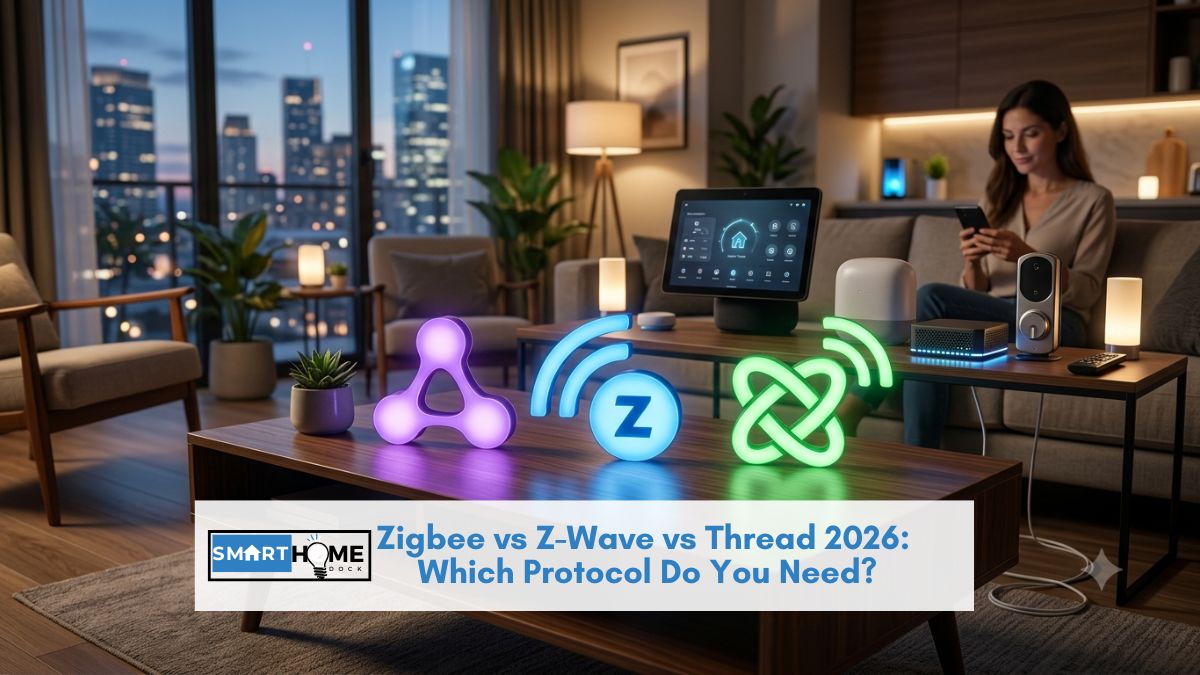
Understandably, the Zigbee vs Z-Wave vs Thread confusion runs deep, three protocols, three different hub requirements, and nobody explains that you don’t have to choose just one.
This guide answers the Zigbee vs Z-Wave vs Thread question in plain language, which protocol your existing devices already use, whether Thread replaces Zigbee and Z-Wave, and exactly what to buy for new purchases in 2026.
Quick Answer: Zigbee vs Z-Wave vs Thread 2026
You don’t choose one. In 2026, the practical answer is: keep existing Zigbee and Z-Wave devices running through a hub that supports both, and buy Thread/Matter devices for new purchases. All three protocols coexist on hubs like Home Assistant, SmartThings, Hubitat, and Homey Pro.
If you’re buying new devices today, choose Thread/Matter where available; any Echo (4th gen+), HomePod Mini, or Nest Hub 2nd gen is already Thread infrastructure you may own.
For Z-Wave specifically: only buy 800-series hardware in 2026; older series have worse range and lower security.
For Zigbee: still has the widest device selection for sensors, switches, and budget bulbs.
First: check the device mapping section below to identify which protocol your existing devices use, then read only the sections relevant to your setup.
Zigbee, Z-Wave, and Thread Can All Coexist: The Most Important Thing to Know First
Most Zigbee vs Z-Wave vs Thread comparisons imply you pick one and build your entire smart home around it. This is inaccurate in 2026 and leads buyers to unnecessary replacements.
Zigbee, Z-Wave, and Thread operate on different radio layers. Consequently, they don’t interfere with each other, a critical fact most buyers miss.
A single hub can run all three simultaneously. Home Assistant with a Zigbee coordinator dongle and a Z-Wave USB stick manages hundreds of devices across both protocols from one interface.
SmartThings and Hubitat do the same natively.
Specifically, the practical 2026 approach used by most experienced smart home builders is:
- Existing Zigbee devices: keep running — no replacement needed
- Existing Z-Wave devices: keep running — no replacement needed
- New purchases: prioritise Thread/Matter where the device category has good Thread options
- New purchases where Thread selection is thin: Zigbee fills the gap, it still has the largest device catalogue for sensors, switches, and budget bulbs
Furthermore, Thread is not a competitor to Zigbee and Z-Wave in the way Wi-Fi is. Thread and Zigbee share the same physical radio layer (802.15.4 at 2.4GHz).
Thread is a different networking stack built on top of the same hardware foundation.
This is why Thread battery life is comparable to Zigbee and Thread range is similar to Zigbee; the underlying radio physics are identical.
Which Protocol Do Your Existing Devices Use?
Before comparing protocols, first identify what you already own. This is the step every buying guide skips, and the one that matters most for your specific situation.
| Brand / Product | Protocol | Hub needed |
|---|---|---|
| Philips Hue bulbs | Zigbee (older) / Matter (newer) | Hue Bridge (Zigbee) or direct Matter pairing |
| IKEA Tradfri | Zigbee (older) / Matter (newer) | IKEA hub (Zigbee) or direct Matter pairing |
| Aqara sensors and switches | Zigbee (most models) | Aqara Hub, Echo (4th gen), SmartThings |
| SONOFF switches and sensors | Zigbee | Any Zigbee coordinator — Home Assistant, SmartThings |
| Schlage Connect lock | Z-Wave | Z-Wave hub — Aeotec, SmartThings + dongle, Hubitat |
| Yale Assure Lock (older) | Z-Wave | Z-Wave hub |
| Yale Assure Lock 2 | Matter (Thread + Z-Wave options) | Thread border router or Z-Wave hub depending on variant |
| Aeotec sensors | Z-Wave | Z-Wave hub |
| Eve sensors and plugs | Thread (Matter) | Thread border router (HomePod Mini, Apple TV 4K, Echo 4th gen) |
| Nanoleaf Essentials A19 | Thread (Matter) | Thread border router |
| TP-Link Tapo / Meross / Shelly | Wi-Fi (some Matter) | No hub needed — connects to router directly |
Alternatively, if your devices aren’t on this list, check the product box or manual. The protocol is usually listed under “connectivity” or “wireless standard.”
Alternatively, search the model name plus “protocol”; the spec is almost always listed on the manufacturer’s product page.
Zigbee vs Z-Wave vs Thread — Full Comparison Table
| Feature | Zigbee | Z-Wave | Thread |
|---|---|---|---|
| Frequency | 2.4GHz | 868–926MHz | 2.4GHz |
| Mesh network | ✅ Yes | ✅ Yes | ✅ Yes |
| Max devices per network | 65,000+ | 232 | 250+ |
| Typical range per hop | 10–20m | 30–100m | 10–30m |
| Wall penetration | Moderate | ✅ Best (sub-GHz) | Moderate |
| Wi-Fi interference risk | ⚠️ Yes (2.4GHz) | ✅ None (sub-GHz) | ⚠️ Yes (2.4GHz) |
| Battery life (sensors) | 1–3 years | 1–2 years | 1–2 years |
| Hub required | ✅ Yes — Zigbee coordinator | ✅ Yes — Z-Wave hub | Thread border router |
| Hub you may already own | Echo (4th gen), SmartThings | Aeotec, Hubitat, SmartThings + dongle | Echo (4th gen), HomePod Mini, Nest Hub 2nd gen |
| Cross-platform (Matter) | Via bridge/hub only | Via bridge/hub only | ✅ Native via Matter |
| Device catalogue (2026) | ✅ Largest — 500M+ devices | Large — 100M+ devices | Growing — best in new releases |
| Ecosystem lock-in | Medium (hub-dependent) | Medium (hub-dependent) | ✅ Low (Matter = multi-platform) |
| Best for | Sensors, budget bulbs, large networks | Locks, large homes, and wall penetration | New purchases, multi-ecosystem homes |
Zigbee in 2026: The Reliable Workhorse with the Largest Device Library
Notably, Zigbee is the most widely deployed smart home mesh protocol, with over 500 million devices shipped.
It powers the majority of smart home sensors, budget bulbs, and smart switches on the market.
IKEA Tradfri, Philips Hue’s older product lines, Aqara’s sensor range, SONOFF switches, and hundreds of other devices all run on Zigbee.
Notably, the Zigbee mesh works by routing signals through multiple devices.
Each mains-powered Zigbee device, a plug, bulb, or switch, acts as a repeater. Additionally, it extends the mesh for battery-powered devices nearby.
Additionally, more mains-powered Zigbee devices in a home mean better coverage for sensors and locks at the edges of the network.
Zigbee’s practical strengths in 2026
- Largest device catalogue: the widest selection of sensors, switches, bulbs, and actuators of any smart home mesh protocol
- Best battery life for sensors: Zigbee sensors frequently achieve 2–3 years on a single battery
- Proven reliability: a mature protocol with over a decade of real-world deployment at scale
- Best value: Zigbee devices are consistently cheaper than Z-Wave equivalents for the same function
- 65,000+ device limit: practically no upper bound for large smart home installations
Zigbee’s honest limitations
- Hub required: every Zigbee setup needs a Zigbee coordinator — a dedicated USB stick or built-in hub radio
- 2.4GHz interference: Zigbee shares the 2.4GHz band with Wi-Fi and Bluetooth. In congested wireless environments, channel conflicts can cause occasional drops
- No native cross-platform: Zigbee devices are only accessible through the hub they’re paired to — unless the hub bridges them to Matter
- Shorter per-hop range than Z-Wave: 10–20m per hop vs Z-Wave’s 30–100m at sub-GHz
💡 Eight years of Zigbee: the honest verdict
Zigbee is still my default recommendation for anyone building a sensor-heavy smart home. Door sensors, motion detectors, temperature sensors, and water leak sensors: the Zigbee options are cheaper, more numerous, and better-tested than Thread equivalents at this point in 2026.
The 2.4GHz interference concern is real but manageable. Set your Zigbee coordinator to channel 25 and your Wi-Fi router to channels 1, 6, or 11; they don’t overlap. Interference problems on Zigbee networks almost always trace back to channel conflicts, not the protocol itself.
Z-Wave in 2026: Best for Locks, Large Homes, and Guaranteed Compatibility
Importantly, Z-Wave operates at sub-gigahertz frequencies, 868MHz in Europe, 908MHz in the US.
This lower frequency gives Z-Wave two significant advantages over Zigbee and Thread: better wall and floor penetration, and zero interference with 2.4GHz Wi-Fi networks.
Furthermore, in a large home with thick walls or concrete floors, Z-Wave often reaches where Zigbee and Thread cannot.
Consequently, Z-Wave is the dominant protocol for smart locks. The majority of serious residential smart locks, Schlage Connect, older Yale Assure variants, and Kwikset SmartCode, run on Z-Wave.
The Z-Wave Alliance’s strict certification process means every Z-Wave device is tested for interoperability before receiving certification.
As a result, Z-Wave has a reliability reputation that Zigbee, with more fragmented implementations, doesn’t always match.
Z-Wave 800-series — the critical 2026 distinction
Z-Wave hardware currently ships in three main chip generations. The 500-series is an outdated, limited-range, older security model.
The 700-series improved range and added S2 security. The 800-series is the current standard, with the best range, lowest power consumption, and SmartStart provisioning for easier setup.
Only buy 800-series Z-Wave devices in 2026. The difference between 700 and the 800-series isn’t cosmetic; the 800-series radio achieves roughly double the range of the 500-series and significantly better battery life. A 500-series Z-Wave lock bought today is already a generation behind the current security standard.
Z-Wave’s honest limitations
- 232 device limit: a hard ceiling per Z-Wave network, rarely a problem for most homes, but relevant for large installations
- Licensed protocol: Z-Wave requires licensed hardware; no DIY Z-Wave radios. This keeps quality high but limits the number of manufacturers
- Smaller device catalogue than Zigbee: fewer budget options, fewer international devices
- Higher device cost: Z-Wave certification costs manufacturers more, and those costs are passed to buyers
- No Thread/Matter native path: Z-Wave devices require a Z-Wave hub; they don’t natively participate in Matter unless bridged
Thread in 2026: The Future Direction — With Important Caveats
Thread is a mesh networking protocol using the 802.15.4 radio standard, the same physical layer as Zigbee. However, Thread builds an IP-based network on top of that radio layer.
Each Thread device gets its own IPv6 address, making it directly addressable on your local network without a translation layer.
Therefore, Thread’s primary role in 2026 is as the transport layer for Matter devices.
When you see a device labelled “Matter over Thread,” the Thread part handles the low-power mesh networking and the Matter part handles the cross-platform compatibility and device description.
Does Thread replace Zigbee?
Not yet, and not completely, even eventually. The thread is the direction in which new smart home device releases are moving.
However, Zigbee’s installed base of 500 million devices doesn’t disappear. Furthermore, Thread’s device catalogue in 2026 is still significantly smaller than Zigbee’s, particularly for sensors and budget devices.
The accurate 2026 picture: Notably, Thread is winning the new-device category, especially for locks, bulbs, and plugs.
Zigbee still leads for sensors, switches, and any device category where Thread equivalents don’t exist yet or cost significantly more. However, both protocols will coexist for at least another decade.
You probably already have Thread infrastructure
First, Thread requires at least one Thread border router, a device that bridges Thread to your local IP network.
Critically, you may already own one without realising it. The following devices include Thread border routers:
- Amazon Echo (4th gen, 2020 or later) ✅
- Amazon Echo Show 10 (3rd gen or later) ✅
- Amazon Echo Hub ✅
- Apple HomePod Mini (any) ✅
- Apple HomePod (2nd gen) ✅
- Apple TV 4K (2nd gen, 2021 or later) ✅
- Google Nest Hub (2nd gen, 2021 or later) ✅
- Eero Pro 6E, Eero Pro 7 ✅
- Samsung SmartThings Station ✅
If you own any device on this list, Thread infrastructure is already in your home. Buy any Thread/Matter device, scan the QR code, and it joins your ecosystem immediately.
Thread’s honest limitations in 2026
- Smaller device catalogue: Thread has significantly fewer device options than Zigbee, particularly for sensors and budget devices
- Still maturing: Thread network management, border router handoffs, and firmware update flows are less polished than mature Zigbee setups
- Battery life is slightly lower than Zigbee: independent testing shows Thread sensors achieving approximately 2 years versus Zigbee’s 3 years on equivalent hardware — the IPv6 stack requires slightly more radio activity
- 2.4GHz band: Thread shares the 2.4GHz band with Zigbee and Wi-Fi, so channel management matters in congested environments
Zigbee vs Thread: What Changes When You Switch
For buyers with existing Zigbee setups evaluating Thread, the comparison is practical rather than theoretical. Here’s what actually changes:
| Consideration | Zigbee | Thread |
|---|---|---|
| Hub required | Dedicated Zigbee coordinator | Thread border router (may already own) |
| Multi-platform | Via hub only | ✅ Native via Matter QR code |
| Device selection | ✅ Much larger — especially sensors | Growing — best for bulbs, plugs, locks |
| Setup complexity | Moderate — coordinator + pairing | ✅ Easier — QR code scan |
| Local processing | ✅ Via hub (Home Assistant, Hubitat) | ✅ Via HomeKit, Home Assistant |
| Battery life (sensors) | ✅ Slightly better (2–3 yrs) | Good (1–2 yrs) |
The practical verdict: don’t replace working Zigbee devices with Thread equivalents. Add Thread devices for new purchases where good Thread options exist.
Furthermore, both protocols run simultaneously on Home Assistant, Hubitat, and SmartThings without conflict.
Z-Wave vs Thread: The Lock and Security Device Question
Specifically, smart locks are the most common reason buyers consider Z-Wave in 2026.
Historically, Z-Wave dominated smart lock compatibility; Schlage, Yale, and Kwikset all built Z-Wave variants as their primary smart integration.
However, Thread is changing this category. The Yale Assure Lock 2 ships in both Z-Wave and Matter (Thread) variants.
Schlage Encode Plus supports Matter directly. Nuki Smart Lock Ultra is Thread-native. For new lock purchases in 2026, Thread/Matter options exist and eliminate the need for a dedicated Z-Wave hub.
However, Z-Wave’s sub-GHz advantage is genuine for locks installed far from the hub — a back door, a garage door, a gate.
Z-Wave penetrates walls and floors better than Thread in the same way that sub-GHz Wi-Fi outranges 5GHz Wi-Fi.
For large properties or challenging building materials, Z-Wave remains the more reliable choice for locks specifically.
The 2026 lock-buying decision: choose Thread/Matter locks if you own a Thread border router and the lock is within a reasonable range.
Choose Z-Wave 800-series if range is a concern, if your property is large, or if you already have a Z-Wave hub.
Best Hubs for Zigbee, Z-Wave, and Thread in 2026
The hub is where all three protocols meet. Not every hub supports all three — here’s what each major option handles:
| Hub | Zigbee | Z-Wave | Thread | Notes |
|---|---|---|---|---|
| Home Assistant | ✅ USB dongle | ✅ USB dongle | ✅ Native Matter | Best all-protocol support. Steepest learning curve. |
| Hubitat Elevation | ✅ Built-in | ✅ Built-in | ✅ Matter | Fully local. No subscription. Strong Z-Wave support. |
| SmartThings Station | ✅ Built-in | ⚠️ USB dongle (~$30) | ✅ Built-in | Best value multi-protocol. Cloud-dependent automations. |
| Aeotec Smart Home Hub | ✅ Built-in | ✅ Built-in | ✅ Thread + Matter | Best for legacy SmartThings migration. Runs SmartThings platform. |
| Homey Pro | ✅ Built-in | ✅ Built-in | ✅ Built-in | Most protocols in one box (adds IR, 433MHz, BT). Expensive (~$399). |
| Amazon Echo (4th gen) | ✅ Built-in | ❌ | ✅ Built-in | No Z-Wave. Good Zigbee + Thread hub for Alexa households. |
For the complete hub comparison with setup complexity, pricing, and local control details, see our best smart home hub guide.
Zigbee vs Z-Wave vs Thread: Which Protocol Should You Buy in 2026?
Therefore, use this Zigbee vs Z-Wave vs Thread framework based on your specific situation, not a generic recommendation that ignores what you already own.
You have no smart home devices yet
First, start with Thread/Matter. Buy a Thread border router if you don’t already own one (HomePod Mini at $99 is the cheapest entry).
Then add Matter-certified devices; every new purchase works with Alexa, Google Home, and HomeKit simultaneously. Add Zigbee only if you need sensor types with no good Thread equivalent yet.
You have existing Zigbee devices
Above all, keep them running. Don’t replace working Zigbee devices with Thread equivalents; the protocols coexist on any good hub.
For new purchases, choose Thread/Matter where good options exist. For sensors specifically, continue buying Zigbee; the selection and price advantage over Thread sensors remain significant in 2026.
You have existing Z-Wave devices
Keep them running. Specifically, a Z-Wave hub manages all current devices: Aeotec, Hubitat, or Home Assistant with Z-Wave USB.
For new locks, evaluate Thread/Matter variants. If the lock is within range of your Thread border router, a Matter lock eliminates the need for Z-Wave hub dependency.
For large properties or challenging building materials, continue with Z-Wave 800-series for new lock purchases.
You want to minimise hub complexity
Finally, choose Thread/Matter for all new purchases. This approach doesn’t require a dedicated hub; the Thread border router built into devices you may already own handles it.
Over time, as Thread device selection improves across all categories, a Thread-first approach eliminates the need for dedicated Zigbee coordinators or Z-Wave hubs.
Frequently Asked Questions — Zigbee vs Z-Wave vs Thread
Can Zigbee and Z-Wave devices work together on the same hub?
Yes, in the Zigbee vs Z-Wave vs Thread comparison, this is the most important practical fact: Home Assistant, Hubitat, SmartThings, and Homey Pro all support both simultaneously.
You need a separate radio for each protocol, typically a Zigbee USB coordinator and a Z-Wave USB stick in a Home Assistant setup.
Both sets of devices appear in the same interface and can trigger each other in automations.
The protocols don’t interfere because they operate on different frequencies, Zigbee at 2.4GHz and Z-Wave at sub-GHz.
Does Thread replace Zigbee?
Not in 2026. In the Zigbee vs Z-Wave vs Thread landscape, Thread is the direction new device releases are moving, particularly for bulbs, plugs, and locks.
However, Zigbee’s device catalogue of 500 million+ deployed devices isn’t going anywhere.
Thread’s sensor selection is still significantly smaller than Zigbee’s. Thread wins for new purchases where good options exist.
Zigbee remains better for sensors and any category where Thread equivalents are limited or expensive.
Both protocols coexist comfortably on hubs like Home Assistant and Hubitat.
What is the difference between Thread and Matter?
Thread is a wireless mesh networking protocol that defines how devices communicate at the radio layer.
Matter is an application-layer standard that defines how devices describe themselves and receive commands across platforms.
Matter runs over Thread for low-power devices (and over Wi-Fi for mains-powered devices).
When a product is labelled “Matter over Thread,” Thread is the radio, and Matter is the language.
You need a Thread border router for the radio layer and a Matter controller (which is built into most modern smart speakers) for the application layer.
See our Matter explainer for the full breakdown.
Which protocol is best for smart locks in 2026?
For new lock purchases with a Thread border router already in place, Thread/Matter locks eliminate the need for a dedicated hub.
Schlage Encode Plus, Yale Assure Lock 2, and Nuki Ultra all support Matter.
For large properties or homes with thick walls and floors where sub-GHz range matters, Z-Wave 800-series remains the more reliable option, specifically because Z-Wave’s lower frequency penetrates building materials better than Thread’s 2.4GHz radio.
The critical rule for Z-Wave locks in 2026: only buy 800-series hardware.
The 500 and 700-series are obsolete.
Do I need a Zigbee hub in 2026?
Yes, if you have Zigbee devices. In any Zigbee vs Z-Wave vs Thread setup, Zigbee devices need a coordinator, a dedicated radio that manages the Zigbee mesh.
Some hubs include a Zigbee coordinator built-in: Amazon Echo (4th gen), Samsung SmartThings Station, Aeotec, and Homey Pro all have built-in Zigbee radios.
Home Assistant requires an external Zigbee USB coordinator such as the Sonoff Zigbee 3.0 USB Dongle Plus (~$20).
If you’re only buying Thread/Matter devices, you don’t need a Zigbee hub, a Thread border router handles everything.
What to Do Next
✅ You have Zigbee or Z-Wave devices and want a hub that manages all three protocols
Our best smart home hub guide covers Home Assistant, Hubitat, SmartThings Station, Aeotec, and Homey Pro with clear guidance on which hub suits each protocol combination and budget.
✅ You want to understand Matter and Thread before buying new devices
Our What is Matter explainer covers how Matter and Thread work together, whether you already own the infrastructure, and which devices are Matter-certified in 2026.
✅ You’re evaluating smart locks and need to choose between Z-Wave and Thread/Matter
Our best smart locks guide covers Schlage Encode Plus (Matter), Yale Assure Lock 2 (Z-Wave and Matter variants), and Nuki Ultra (Thread) with clear guidance on which to choose based on hub compatibility and property size.
