
This article contains affiliate links. SmartHomeDock earns a small commission if you buy through them, at no extra cost to you.
Samsung discontinued its SmartThings hub hardware in 2023. If you are looking for dedicated SmartThings hardware in 2026, the Aeotec Smart Home Hub is your only option.
Aeotec holds the SmartThings hardware licence, builds the hub to Samsung’s specification, and Samsung directs all SmartThings hardware enquiries to them.
That positioning sounds smooth. The buying decision is not. In 2026, the Aeotec hub faces sharper competition than at launch, its promised local control never materialised, and a newer Aeotec Hub 2 exists that drops Z-Wave support entirely.
Before spending $150, buyers need to know exactly which situations this hub is right for and which it is not.
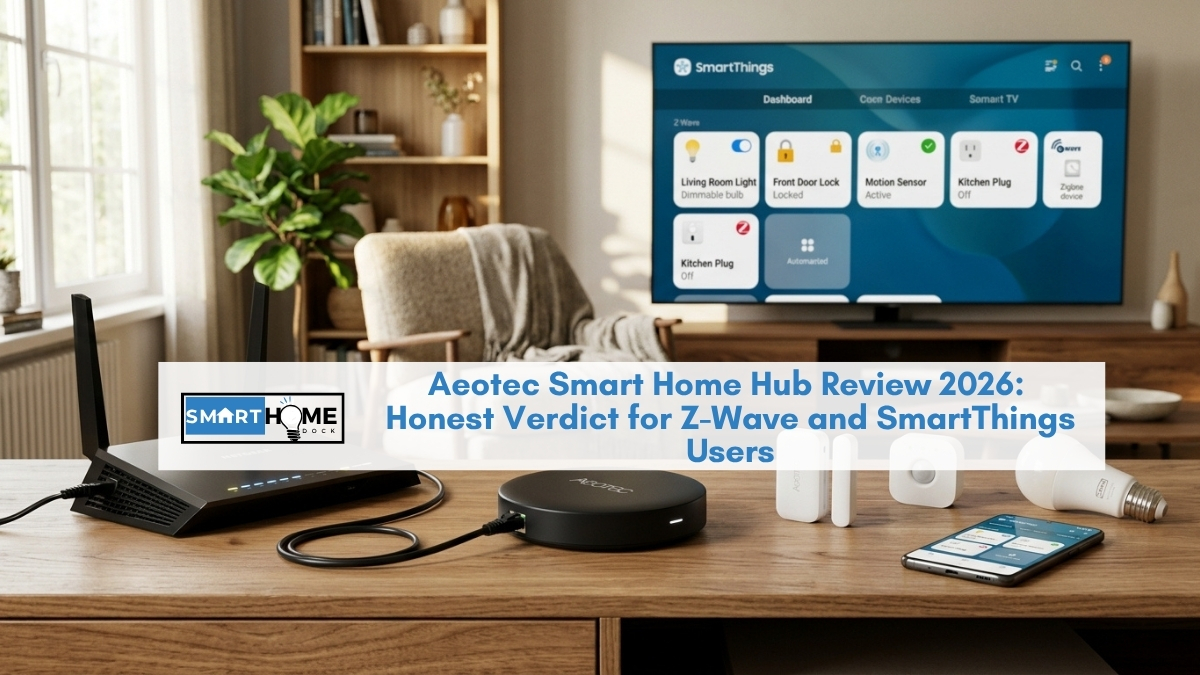
This Aeotec Smart Home Hub review covers both current models, the cloud dependency that every other review buries, the honest comparison with Hubitat, and the specific buyer profiles where this hub is genuinely the right choice.
Quick Answer: Aeotec Smart Home Hub Review 2026
The Aeotec Smart Home Hub V3 (~$130 to $150) is the right choice for three specific situations: you have existing Z-Wave devices (locks, sensors, switches) and want to add Matter devices without replacing them; you use SmartThings and Samsung appliances and want unified dashboard control; or you are migrating from a SmartThings V2 or V3 hub and want the most seamless transfer.
Not the right choice if: you are starting fresh with no Z-Wave devices (the SmartThings Station or Echo 4th gen costs less and handles Matter well), or if local control during internet outages is critical (the Aeotec hub is cloud dependent: automation stops when broadband goes down).
Rating: 4/5 for its intended audience (Z-Wave and SmartThings households). 2.5/5 for new buyers without existing Z-Wave investment.
Aeotec Hub 2 vs V3: Which One You Actually Want
Aeotec currently sells two models, and the distinction matters significantly.
| Feature | Aeotec Smart Home Hub V3 | Aeotec Hub 2 (2024) |
|---|---|---|
| Z-Wave radio | ✅ Z-Wave 700 series | ❌ Removed |
| Zigbee | ✅ Zigbee 3.0 | ✅ Zigbee 3.0 |
| Matter / Thread | ✅ Matter gateway + Thread border router | ✅ Matter gateway + Thread border router |
| Processor | 528 MHz | Faster (updated chipset) |
| Price | ~$130 to $150 | ~$149 to $169 |
| Buy if | You have Z-Wave devices | Matter and Zigbee only, no Z-Wave |
Specifically, the rest of this review covers the Aeotec Smart Home Hub V3, the Z-Wave model that most buyers are researching.
Notably, for buyers without any Z-Wave devices, the Hub 2 is faster and costs about the same.
However, if you have Schlage Connect locks, Yale Assure Z-Wave, Aeotec leak sensors, or any Z-Wave switches from the 2015 to 2022 era, the V3 is the only current mainstream hub that keeps those devices alive alongside new Matter additions.
[AMAZON AFFILIATE LINK: Aeotec Smart Home Hub V3]
Aeotec Smart Home Hub V3 Specifications
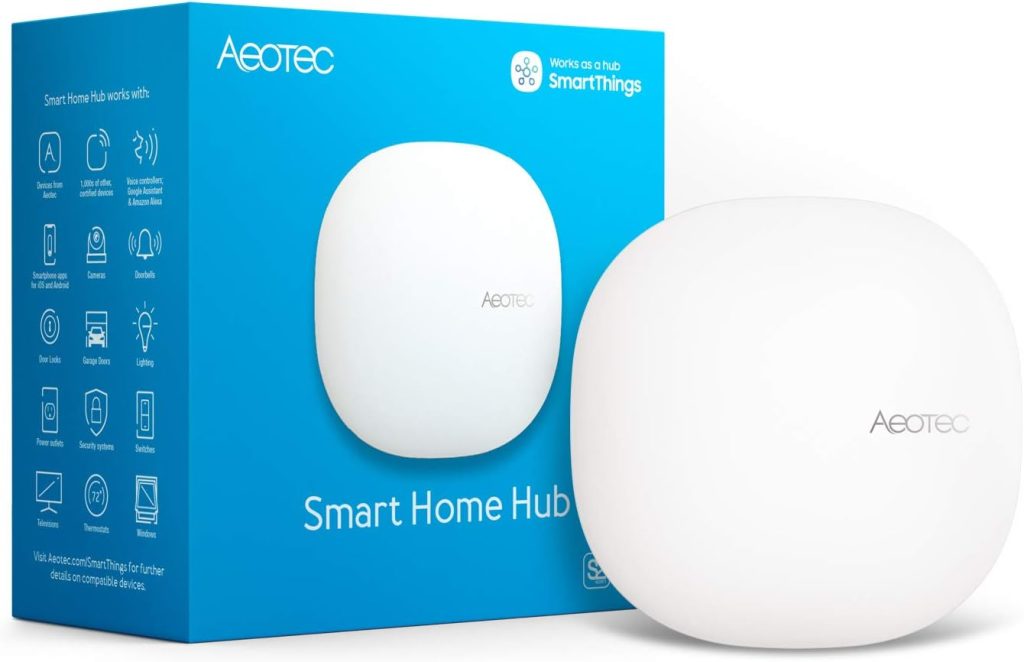
| Protocols | Z-Wave 700 series, Zigbee 3.0, Wi-Fi (802.11ac), Matter gateway, Thread border router |
| Z-Wave capacity | Up to 232 devices |
| Zigbee capacity | Up to 128 devices |
| Connectivity | Ethernet + Wi-Fi. No Bluetooth, no IR |
| Processor / RAM / Storage | 528 MHz, 2 GB RAM, 4 GB storage |
| Dimensions | 4.9 x 4.9 x 1.1 inches |
| Local control | ❌ Cloud dependent (see Limitations section) |
| Battery backup | ❌ Not included |
| Voice assistants | Alexa, Google Assistant. No Apple HomeKit or Siri. |
| App | Samsung SmartThings (iOS and Android) |
| Subscription | None required |
| Warranty | 1 year |
| Price (August 2026) | ~$127 to $150 on Amazon |
Who the Aeotec Smart Home Hub Is Right For
The Aeotec hub is a specific tool for specific situations. It is not the best hub for every buyer.
Buy the Aeotec V3 if you are in one of these situations
Situation 1: You have existing Z-Wave devices. If your home has Z-Wave locks (Schlage Connect, Yale Assure Z-Wave, Kwikset Z-Wave), Z-Wave sensors, or Z-Wave switches, the Aeotec V3 is the only current mainstream hub that speaks Z-Wave, Zigbee, and Matter simultaneously. Specifically, Z-Wave’s sub-1 GHz frequency penetrates walls better than 2.4 GHz Zigbee in older homes with plaster or concrete walls. Replacing these devices to move to a Matter-only hub would cost hundreds or thousands of dollars. The Aeotec V3 keeps them running while you add new Matter devices incrementally.
Situation 2: You are migrating from a SmartThings V2 or V3 hub. Notably, the migration to Aeotec is as smooth as any hub migration gets. Your SmartThings account, automations, and routines transfer to the Aeotec hub because it uses the same SmartThings platform. Most cloud-connected devices re-discover automatically. Z-Wave and Zigbee devices require re-pairing at the radio level, but the SmartThings app guides this process. If you are moving from Samsung’s older hardware, Aeotec is the natural next step.
Situation 3: You have Samsung appliances. Furthermore, the SmartThings platform is unique in surfacing Samsung washing machines, dryers, refrigerators, air conditioners, and dishwashers alongside smart home devices in a single dashboard. If your home runs Samsung appliances and you want unified control through one app, the Aeotec hub is the only dedicated hub that delivers this. No other hub at this price point integrates Samsung appliances natively.
Do not buy the Aeotec V3 if you are in these situations
Starting fresh with no Z-Wave devices: a fourth-generation Amazon Echo ($50 to $100) has a built-in Zigbee hub, handles Matter via Alexa, and costs a fraction of the Aeotec. A HomePod Mini ($99) handles Matter and Thread for Apple users. The SmartThings Station ($80) offers a Matter-focused SmartThings experience without Z-Wave at a lower price. None of them require a $150 dedicated hub purchase.
Local control is a requirement: see the Limitations section below. The Aeotec hub is cloud dependent. If your internet goes down, you cannot control devices through the SmartThings app even if both your phone and the hub are on the same home network. If this matters to you, Hubitat is the correct choice.
You need Apple HomeKit: the Aeotec hub works with Alexa and Google Assistant but has no native HomeKit support. iPhone users who want HomeKit integration need to look at Aqara Hub M3, Homey Pro, or Home Assistant with a HomeKit bridge.
The One Limitation Every Review Buries: Aeotec Hub Local Control
This is the section most Aeotec reviews bury on page three after listing twenty features. It belongs here, before the product sections.
The Aeotec Smart Home Hub requires a working internet connection for the SmartThings app to control your devices.
When your broadband goes down, the SmartThings app shows your devices, but commands do not execute, even if your phone and the hub are on the same home Wi-Fi network.
Your Z-Wave lock cannot be unlocked through the app. Your lights cannot be controlled through routines. Scheduled automations stop running.
Aeotec stated in 2021 that local processing was coming. As of August 2026, it has not arrived.
The SmartThings platform does run some SmartThings Edge drivers locally for specific devices, which means basic device state reporting may continue offline, but full automation execution remains cloud-dependent for most setups.
For most households, broadband outages are infrequent and local control during outages is not a daily concern.
For buyers where reliable local control matters (security lighting that must activate regardless of internet status, locks that must respond in an emergency), the Hubitat Elevation C-8 Pro is the correct choice. It processes everything locally and costs approximately the same.
What happens during a broadband outage with the Aeotec hub
SmartThings app: shows devices but commands fail silently.
Physical switches: work normally for locally wired devices.
Alexa and Google Home: basic device control may work if local Alexa routines are configured, but SmartThings-dependent routines will not execute.
Scheduled automations: most do not run. The hub cannot trigger routines without the SmartThings cloud.
Z-Wave, Zigbee, and Matter: How the Protocols Actually Perform
Z-Wave performance
Specifically, the Z-Wave 700 series radio is the strongest argument for choosing the Aeotec V3 over any other hub in 2026.
Z-Wave 700 supports up to 232 devices, runs at 908.4 MHz (in the US), and builds a self-healing mesh network where each device repeats the signal.
Specifically, sub-1 GHz penetrates older building materials (plaster walls, brick, concrete) more reliably than 2.4 GHz Zigbee signals.
In testing, Z-Wave locks and sensors at 30 to 40 feet through two plaster walls maintained consistent connectivity where Zigbee devices showed intermittent drops.
Consequently, for homes with Z-Wave devices already installed, the Aeotec hub maintains that network without range compromises.
Adding a new Z-Wave device requires putting the hub into pairing mode (holding the hub button until the LED turns blue) and pressing the pairing button on the device. Most modern Z-Wave devices pair within 30 seconds.
Zigbee performance
Zigbee 3.0 handles up to 128 devices and builds a similar self-healing mesh. Notably, response times in testing averaged under two seconds for light control across 12 Zigbee bulbs.
Notably, the Aeotec hub’s Zigbee radio is solid but not exceptional. Dedicated Zigbee coordinators like the ConBee II or the Philips Hue Bridge deliver marginally better Zigbee range in large homes.
For most residential setups, the Aeotec’s built-in Zigbee is sufficient.
Matter support
Notably, Matter support arrived through firmware updates rather than as a hardware feature at launch.
The Aeotec hub acts as a Matter controller, commissioning Matter-certified devices into SmartThings via QR code scan.
SmartThings then exposes those devices to Alexa, Google Home, and other platforms through cloud integrations.
Additionally, the hub functions as a Thread border router, allowing Matter-over-Thread devices from brands like Eve and Nanoleaf to communicate through the hub’s Thread network.
Notably, the practical limitation is that Matter commissioning through SmartThings adds an extra step compared to commissioning directly to Alexa or Google Home.
For buyers who primarily use Alexa or Google Home for daily control, commissioning devices directly to those platforms and using the Aeotec hub only for Z-Wave and Zigbee is often the cleaner workflow.
For a full protocol explanation, see our Zigbee vs Z-Wave vs Thread guide and our Matter explainer.
The SmartThings App: What You Are Actually Buying
Notably, the Aeotec hub has no app of its own. Samsung’s SmartThings app handles everything. This matters because the hub is fundamentally a radio gateway.
The intelligence, automation logic, and user interface all live in SmartThings.
Furthermore, SmartThings is a genuinely capable platform. Automations (called Routines in SmartThings) support time-based triggers, device state triggers, presence detection, and multi-step action sequences.
The interface is card-based and approachable: each connected device is a card, rooms group devices, and the Routines tab handles all automation building.
Creating a “when the front door opens after sunset, turn on the hallway light” routine takes under two minutes.
Alexa integration is strong. SmartThings exposes all connected devices to Alexa automatically, and room-level voice commands work reliably.
“Alexa, turn off all lights” operates correctly across Z-Wave, Zigbee, and Matter devices simultaneously. Google Home integration is similarly solid.
The SmartThings community forum is one of the most active smart home communities online, with solutions for almost any device compatibility or automation question.
Furthermore, the weak areas include limited camera integration compared to dedicated security platforms. Energy monitoring requires compatible devices and is not as polished as Sense or Emporia. Home Assistant’s automation depth significantly exceeds SmartThings for complex conditional logic, though at the cost of a steep setup learning curve.
Eight years of multi-protocol hubs: why this one holds up
I have run SmartThings V2, Hubitat, and Home Assistant across different homes over eight years.
The Aeotec V3 is the hub I recommend to people with existing Z-Wave installations who ask me what to buy. Not because it is the most powerful hub available.
It is not. Hubitat processes faster and runs fully locally. Home Assistant is far more capable for advanced automation.
The reason I recommend the Aeotec V3 for Z-Wave households is practical: SmartThings is the most forgiving platform for non-technical users, the migration from older SmartThings hardware is the least painful of any hub transition, and for homes running mixed Z-Wave and Matter devices, there is nothing else at this price point that handles both without significant compromise. The cloud dependency is a real limitation.
For most households, it is an acceptable one.
Aeotec Smart Home Hub vs Hubitat Elevation C-8 Pro
Importantly, these two hubs are priced within $20 of each other and serve similar audiences.
The decision between them is the most important comparison in this category.
| Factor | Aeotec V3 (~$130 to $150) | Hubitat Elevation C-8 Pro (~$150) |
|---|---|---|
| Local control | ❌ Cloud required | ✅ Fully local |
| Z-Wave | ✅ Z-Wave 700 | ✅ Z-Wave 800 LR (longer range) |
| Zigbee | ✅ Zigbee 3.0 | ✅ Zigbee 3.0 |
| Matter | ✅ Via SmartThings | ✅ Matter 1.5 |
| Apple HomeKit | ❌ Not supported | ✅ Native HomeKit support |
| Automation complexity | Good. Approachable for non-technical users. | Excellent. Steeper learning curve. |
| Samsung appliance integration | ✅ Native SmartThings integration | ❌ No native Samsung integration |
| Best for | SmartThings users, Samsung homes, non-technical buyers | Privacy-conscious buyers, local control priority, advanced automation |
Consequently, the honest verdict is that Hubitat is the objectively stronger hub on technical specifications.
Local processing, Z-Wave 800 LR (meaningfully longer range), native HomeKit, and Matter 1.5 versus Aeotec’s Z-Wave 700 and cloud-dependent operation.
Consequently, for buyers without a specific SmartThings commitment or Samsung appliance dependency, Hubitat is the better platform to invest in.
However, the Aeotec wins specifically when: you are migrating from SmartThings and don’t want to rebuild automations from scratch, you have Samsung appliances you want in the same dashboard, or you want the most approachable non-technical smart home hub experience at this price.
Aeotec Smart Home Hub Setup: What to Expect
Specifically, setup is the area where the Aeotec hub earns its approachable reputation.
- Connect power and Ethernet. Ethernet is recommended over Wi-Fi for hub reliability. Plug the hub into power and connect the Ethernet cable to your router. The LED turns green when the hub is running.
- Download the SmartThings app and sign in with or create a Samsung account. From the home screen, tap the plus sign and select “Add Device,” then “Hub” from the category list.
- Scan the QR code on the hub to register it to your account. The app guides you through naming the hub and assigning it to a location.
- Add devices. Cloud-connected devices (Philips Hue, Ring, Nest, SmartLife) connect via their respective SmartThings integrations. Zigbee and Z-Wave devices pair by putting the hub in discovery mode (tap the “Add Device” button in-app, or hold the hub button until the LED turns blue) and triggering the pairing sequence on the device itself.
- Build your first Routine. In the SmartThings app, tap the Automations tab, then the plus sign to create a Routine. Choose a trigger (time, device state, location), then add actions across any connected device regardless of protocol.
For SmartThings V2 or V3 migrants, the process is slightly different. Specifically, cloud-connected integrations re-link automatically when you sign into your existing Samsung account.
Z-Wave and Zigbee devices need to be excluded from the old hub (excluded, not just unpaired) and then freshly paired to the Aeotec hub.
This is time-consuming for large Z-Wave networks but is well-documented in the SmartThings community forum.
Consequently, initial setup from unboxing to first automation typically takes 30 to 60 minutes for a smooth setup.
For complete setup guidance, see our smart home hub guide, which covers SmartThings alongside all major hub alternatives.
Pros and Cons
| Pros | Cons |
|---|---|
| Only mainstream hub combining Z-Wave 700, Zigbee 3.0, and Matter in one box | Cloud dependent: no local control without internet |
| Samsung SmartThings platform: approachable, large community, solid automation | No Apple HomeKit or Siri support |
| Samsung appliance integration: unified dashboard for SmartThings and Samsung devices | No battery backup: hub goes offline during power outages |
| Smooth migration path from SmartThings V2 and V3 hardware | Z-Wave 700 vs Hubitat’s Z-Wave 800 LR (shorter range in challenging environments) |
| Thread border router: supports Matter-over-Thread devices natively | Priced significantly higher than the original SmartThings Hub V3 at launch ($70) |
| No subscription required. One-year warranty. | Overpriced for buyers with no Z-Wave devices. Cheaper alternatives handle Matter better. |
Frequently Asked Questions: Aeotec Smart Home Hub
Is the Aeotec Smart Home Hub the same as Samsung SmartThings?
The Aeotec Smart Home Hub runs on the SmartThings platform and uses the same SmartThings app, so from a software perspective it is functionally identical to the Samsung SmartThings V3 hub.
Samsung discontinued its own-branded SmartThings hardware in 2023 and licensed production to Aeotec.
The hardware is built by Aeotec to Samsung’s specification using the same chipset, Zigbee radio, and Z-Wave radio as the SmartThings V3.
Aeotec is the only company currently authorised to produce SmartThings-certified dedicated hub hardware.
Does the Aeotec hub work without internet?
No, not fully. The Aeotec Smart Home Hub requires a working internet connection for the SmartThings app to control devices and run automations.
If your broadband goes down, commands issued through the app do not execute, even if your phone and hub are on the same home network.
SmartThings Edge drivers do allow some basic device state reporting locally, but full automation execution is cloud dependent.
This is the most significant limitation of the Aeotec hub. For fully local processing, the Hubitat Elevation C-8 Pro is the correct alternative at a similar price.
What is the difference between the Aeotec Hub V3 and Hub 2?
The Aeotec Hub V3 includes Z-Wave 700, Zigbee 3.0, Matter, and Thread support.
The newer Aeotec Hub 2 removes Z-Wave entirely, runs on a faster processor, and retains Zigbee, Matter, and Thread.
For any household with existing Z-Wave devices (locks, sensors, switches), the V3 is the correct model.
The Hub 2 is only the better choice for buyers with no Z-Wave devices who want slightly faster processing, and at that point, the SmartThings Station or an Echo 4th gen are worth comparing.
Does the Aeotec Smart Home Hub work with Alexa and Google Home?
Yes, the Aeotec SmartThings hub integrates with both Alexa and Google Home.
All SmartThings-connected devices appear in the Alexa and Google Home apps automatically through the SmartThings skill or integration.
Voice commands including room-level control work reliably across Z-Wave, Zigbee, and Matter devices once they are paired to the hub.
The hub does not support Apple HomeKit or Siri natively, though Home Assistant bridge workarounds exist for advanced users.
Is the Aeotec Smart Home Hub Review Verdict Worth It in 2026?
It depends entirely on your existing device ecosystem.
For households with Z-Wave devices purchased between 2015 and 2022, the Aeotec Smart Home Hub review conclusion is clear: yes, at $130 to $150 it is the most practical way to maintain a Z-Wave network while adding Matter devices.
For buyers without Z-Wave devices starting fresh, it is overpriced for the use case.
A fourth-generation Echo ($50 to $100) handles Matter and Zigbee, a HomePod Mini ($99) handles Matter and Thread for Apple users, and neither requires a $150 hub investment.
The Aeotec SmartThings hub earns its price for Z-Wave households. It does not earn it for Matter-only setups.
Final Verdict: Aeotec Smart Home Hub 2026
Buy the Aeotec Smart Home Hub V3 if:
- You have Z-Wave devices (locks, sensors, switches) and want to add Matter without replacing them
- You are migrating from a SmartThings V2 or V3 hub and want the smoothest possible transition
- Your home runs Samsung appliances and you want a unified SmartThings dashboard
- You want a capable, approachable hub without Home Assistant’s learning curve
Do not buy the Aeotec hub if:
- You have no Z-Wave devices: the Echo 4th gen or HomePod Mini costs half as much and handles Matter
- Local control during internet outages is a requirement: choose Hubitat Elevation C-8 Pro instead
- You use Apple HomeKit: the Aeotec hub has no native HomeKit support
- You want advanced automation depth: Home Assistant significantly outperforms SmartThings for complex conditional logic
Rating: 4/5 for Z-Wave and SmartThings households. 2.5/5 for new buyers without existing Z-Wave investment. The hub does exactly what it says for the right audience.
The limitation is that the right audience is narrower in 2026 than it was at launch, because Matter has reduced the need for a protocol-bridging hub for new setups.
For existing SmartThings and Z-Wave households, it remains the most practical option at this price.
