


Disclosure: This article may contain affiliate links. SmartHomeDock participates in the Amazon Associates Program and may earn commissions from qualifying purchases at no extra cost to you.
You’d think buying a light bulb would be simple. Screw it in, flip the switch, done. Then you open Amazon, search “smart bulb,” and suddenly there are 400 options across six different wireless protocols and four different ecosystems, and half of them won’t work with the voice assistant you already own.
I’ve been testing smart bulbs across Alexa, Google Home, and HomeKit setups for over eight years, and the truth is that the best smart bulbs aren’t necessarily the brightest or the cheapest.
They’re the ones that connect reliably to your ecosystem, respond without lag, and don’t require a PhD in wireless networking to set up.
This guide cuts through the noise with 10 tested picks organised by who they’re actually for — not just sorted by star rating. Whether you’re an Alexa household, a HomeKit purist, or someone who just wants a decent colour bulb for under $15, there’s a specific recommendation here for you.
Quick Answer: The best smart bulbs in 2026 are the Philips Hue White and Color Ambiance (best overall for reliability and ecosystem depth), the TP-Link Tapo L535E (best value with excellent app), and the Nanoleaf Essentials A19 (best for Matter and Thread). For Alexa-only homes, the Govee Wi-Fi LED is hard to beat on price. For HomeKit users, the Nanoleaf Essentials gives you Thread mesh and full Siri control without a bridge.
Best Smart Bulbs 2026: Quick Comparison Table
I’ve included ecosystem compatibility, protocol, brightness, and whether a hub is required, the four factors that matter most when choosing smart bulbs for your home.
| Smart Bulb | Best For | Price | Lumens | Protocol | Hub Needed | Works With |
|---|---|---|---|---|---|---|
| Philips Hue White & Color A19 | Best overall | $50 | 1,100 | Zigbee + BT | Optional (Bridge) | Alexa, Google, HomeKit, Matter |
| TP-Link Tapo L535E | Best value | $13 | 1,100 | Wi-Fi | No | Alexa, Google, Matter |
| Nanoleaf Essentials A19 | Best for Matter/Thread | $20 | 1,100 | Thread + BT | Thread border router | Alexa, Google, HomeKit, Matter |
| Govee Wi-Fi LED Bulb | Best budget for Alexa | $10 | 800 | Wi-Fi + BT | No | Alexa, Google |
| LIFX A19 Color | Best no-hub colour | $35 | 1,100 | Wi-Fi | No | Alexa, Google, HomeKit |
| Philips Hue Essentials A19 | Best mid-range Hue | $25 | 1,100 | Zigbee + BT | Optional (Bridge) | Alexa, Google, HomeKit, Matter |
| Sengled Smart LED + Motion | Best for outdoor/security | $25 | 1,200 | Zigbee | Yes | Alexa, SmartThings |
| GE Cync Dynamic Effects | Best for entertainment | $25 | 1,100 | Wi-Fi + BT | No | Alexa, Google |
| Kasa KL110 Dimmable | Best white-only | $13 | 800 | Wi-Fi | No | Alexa, Google |
| AiDot Linkind Matter A19 | Best ultra-budget Matter | $8 | 800 | Wi-Fi + Matter | No | Alexa, Google, HomeKit, SmartThings |
How to Choose the Right Smart Bulb for Your Home
Before spending money on smart bulbs, answer these three questions they’ll eliminate 80% of the options and leave you with the right pick.
Which voice assistant do you use? This is the most important factor. If you have an Echo, every bulb on this list works with Alexa but some integrate more deeply than others. If you’re a HomeKit household, your options narrow to Philips Hue, Nanoleaf, LIFX, and anything Matter-certified. For a full breakdown of Alexa-specific options, see our best smart bulbs for Alexa guide.
Do you want colour or just white? Colour-changing bulbs cost $15–$50 each, while white-only or tuneable white bulbs start at $8. If you mainly want to schedule lights on and off or dim them at bedtime, a tuneable white bulb saves significant money without sacrificing much functionality. Colour is worth it for accent lighting, entertainment areas, and mood lighting, but probably overkill for your hallway.
Do you have or want a hub? Hubless Wi-Fi bulbs are the simplest to set up: screw in, connect through the app, done. However, loading your Wi-Fi with 20+ bulbs can cause network congestion. Zigbee bulbs (Philips Hue) and Thread bulbs (Nanoleaf) use separate mesh networks that don’t touch your router, which makes them more reliable in larger setups. If you’re buying more than 10 bulbs, invest in a hub-based system.
💡 Expert Tip:
The number one complaint I hear from readers about smart bulbs is “they stop responding randomly.” Nine times out of ten, that’s a Wi-Fi congestion issue — too many bulbs on one router. If you’re outfitting more than two rooms, switch to Zigbee (Philips Hue) or Thread (Nanoleaf) bulbs that run on their own mesh network. Your smart bulbs shouldn’t be fighting your Netflix stream for bandwidth.
The 10 Best Smart Bulbs in 2026 — Detailed Reviews
1. Philips Hue White and Color Ambiance A19 — Best Smart Bulb Overall
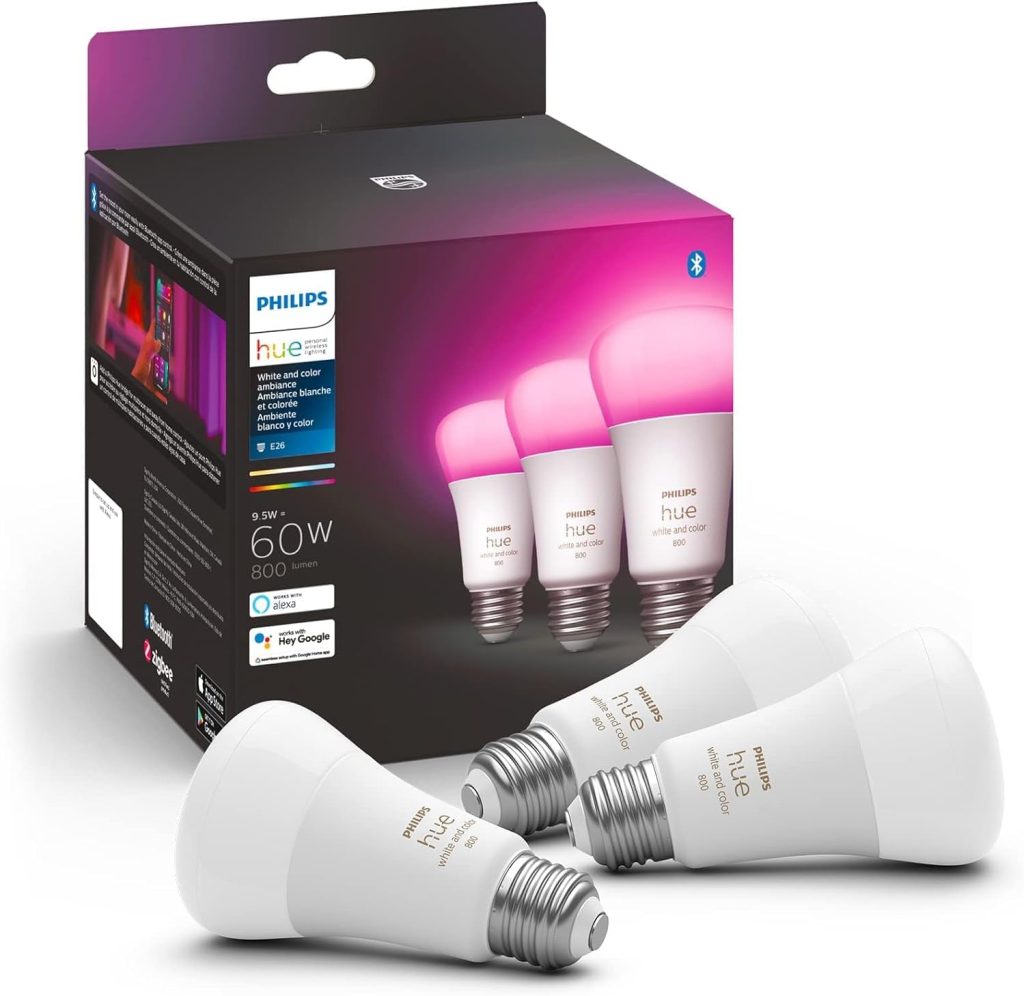
Philips Hue has held the top spot in every major smart bulb roundup for over five years, and after testing the current generation extensively, I understand why.
The reliability is unmatched when you tap “on” in the app or ask Alexa to turn on the lights; Hue bulbs respond within 100 milliseconds, every single time. That consistency matters more than any spec sheet number.
At 1,100 lumens with 16 million colours, the Hue A19 delivers bright, accurate light across the entire colour spectrum.
The tuneable white range (2,000K–6,500K) covers everything from warm candlelight to energising daylight.
Moreover, the Hue app provides the deepest customisation of any smart bulb platform — scenes, room-by-room scheduling, circadian rhythm presets, and entertainment sync with music and movies.
The Hue Bridge is now optional you can run up to 10 bulbs via Bluetooth without it. However, I strongly recommend the Bridge for anyone buying more than a few bulbs.
It unlocks remote access, Zigbee mesh networking, and automations that trigger based on time, motion, or other device states.
The 2026 Bridge Pro supports 150+ devices and runs locally, meaning your lights work even when the internet goes down.
The only real drawback is price. At $50 per colour bulb and $200 for the starter kit, Hue is the most expensive option on this list.
Nevertheless, for anyone building a serious smart lighting setup that needs to be rock-solid reliable, Hue remains the benchmark that every other smart bulb is measured against.
- Best for: Anyone who wants the most reliable, deepest smart bulb ecosystem available
- Works with: Alexa, Google Home, HomeKit, SmartThings, Matter (via Bridge)
- Honest limitation: Most expensive option — the starter kit is a real investment
2. TP-Link Tapo L535E — Best Value Smart Bulb
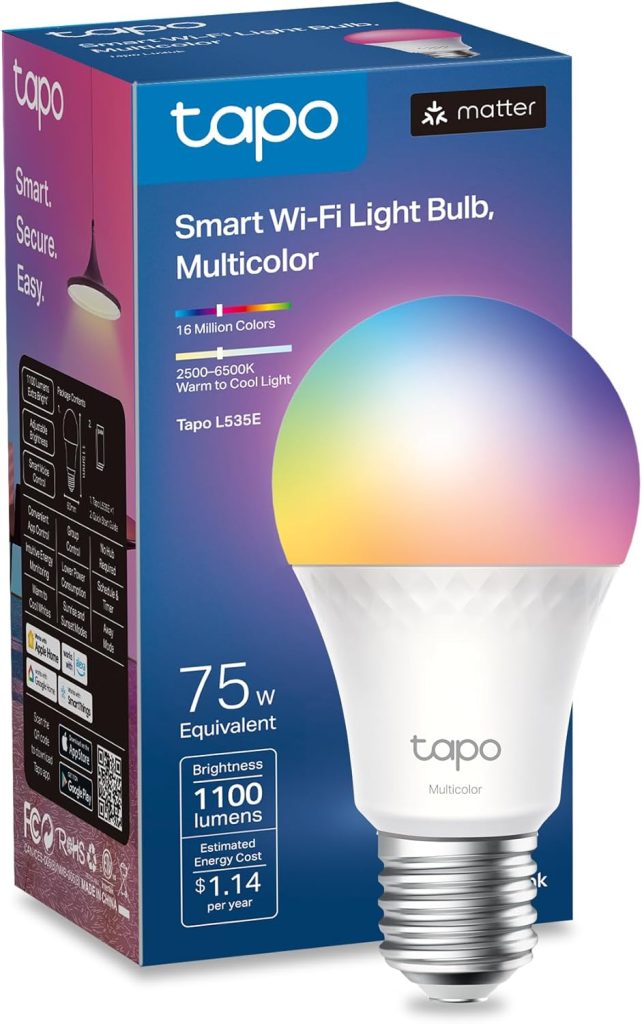
The Tapo L535E is the smart bulb I recommend to anyone who asks, “What should I buy first?” at $13 per bulb with full colour, 1,100 lumens, and one of the best smart bulb apps I’ve used.
CNN Underscored named it their top pick after months of testing, and after running four of them in my own home, I agree with that assessment.
The Tapo app is genuinely intuitive and cleaner than the Hue app for basic controls and significantly better than Govee’s or Wyze’s.
Setup takes under two minutes per bulb over Wi-Fi, with no hub required. Colour accuracy is impressive at this price point, and the whites are warm and natural rather than the washed-out look you get from some budget competitors.
The Tapo L535E also supports Matter, which means it works across Alexa, Google Home, and SmartThings simultaneously.
The missing piece is HomeKit, while Matter should enable it, Tapo’s Matter implementation doesn’t currently extend to Apple’s ecosystem. For HomeKit users, the Nanoleaf at #3 is the better choice.
- Best for: First-time smart bulb buyers who want great quality without the Hue price tag
- Works with: Alexa, Google Home, SmartThings, Matter
- Honest limitation: No native HomeKit support despite Matter certification
3. Nanoleaf Essentials A19 — Best Smart Bulb for Matter and Thread
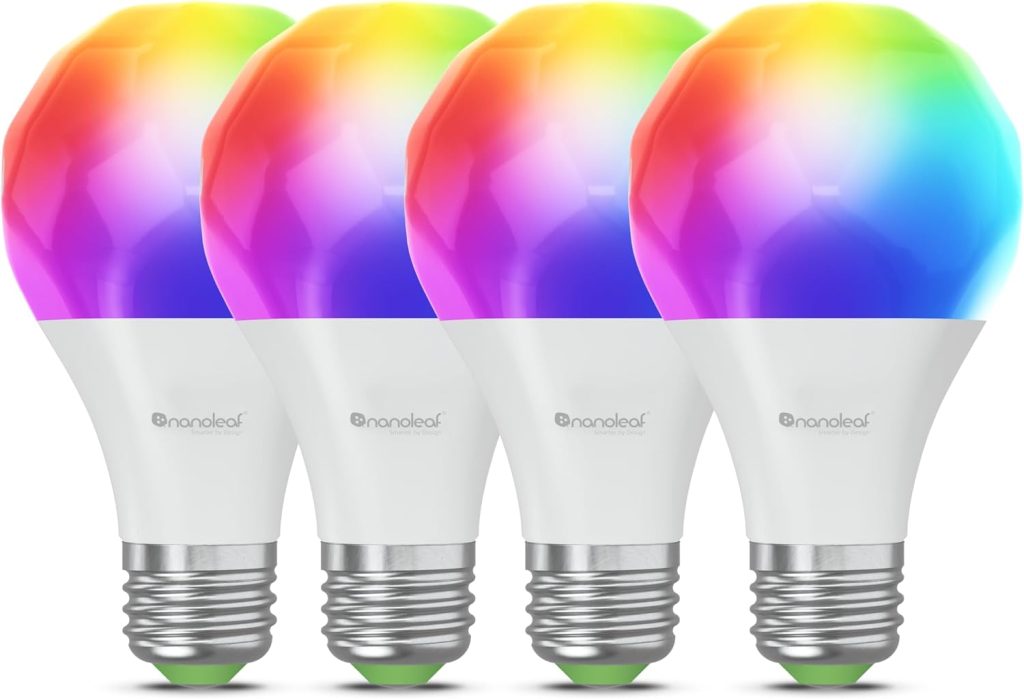
If you want to future-proof your smart lighting, the Nanoleaf Essentials A19 is the bulb to buy. It runs on Thread, a mesh networking protocol that’s faster, more reliable, and more power-efficient than Wi-Fi.
With a Thread border router (built into HomePod mini, Apple TV 4K, and some Google Nest devices), these bulbs form a self-healing mesh network that strengthens as you add more bulbs.
Nanoleaf also provides full Matter support, which means cross-platform compatibility with Alexa, Google Home, HomeKit, and SmartThings.
For HomeKit users specifically, this is one of the best smart bulbs available because Thread gives you local control through Apple’s Home app with near-instant response times.
At $20 per bulb, the Nanoleaf Essentials sits in the sweet spot between budget picks and the Hue premium. Colour quality is excellent, with rich saturated tones and a wide tuneable white range.
The app is functional if not exceptional, most users will control these through their voice assistant or ecosystem app rather than the Nanoleaf app directly.
- Best for: HomeKit users, anyone building a Thread mesh network, future-proofing with Matter
- Works with: Alexa, Google Home, HomeKit, SmartThings, Matter
- Honest limitation: Requires a Thread border router for best performance — Bluetooth-only mode is limited
4. Govee Wi-Fi LED Bulb — Best Budget Smart Bulb for Alexa
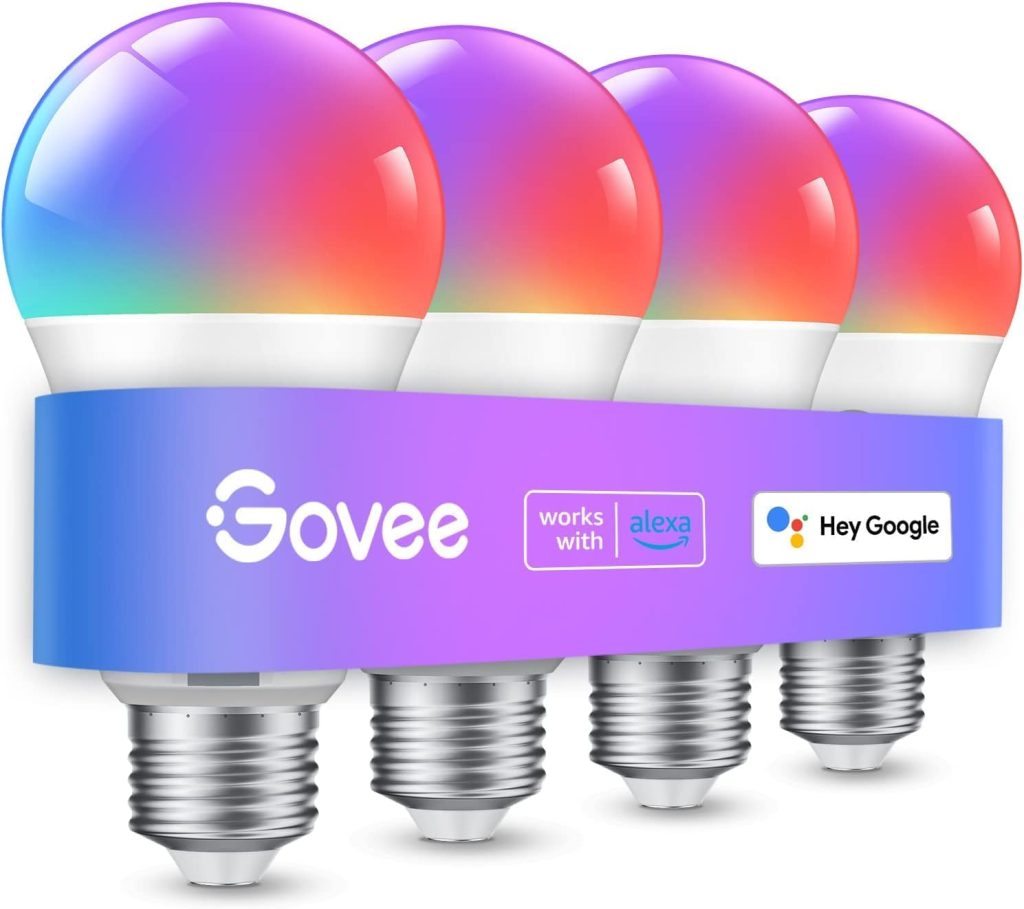
At roughly $10 per bulb (often cheaper in multi-packs), the Govee Wi-Fi LED is the easiest way to start building smart lighting without a meaningful financial commitment.
It connects directly over Wi-Fi, no hub, no bridge, and works with Alexa and Google Home out of the box.
The Govee app includes music sync and dynamic scene modes that are genuinely impressive at this price point.
Colours are vibrant for accent lighting, though they lose brightness compared to the Hue or Nanoleaf when displaying deeper shades. White light quality is perfectly adequate for everyday use.
The main trade-off is build quality and long-term reliability. In my testing, Govee bulbs occasionally dropped their Wi-Fi connection after router reboots and took a few minutes to reconnect.
For a $10 bulb that’s acceptable, but for a whole-house setup, consider stepping up to the Tapo or Nanoleaf. For an extended look at budget Alexa-compatible options, see our best smart bulbs for Alexa guide.
- Best for: Budget buyers, Alexa households testing smart lighting for the first time
- Works with: Alexa, Google Home
- Honest limitation: Colours lose brightness at saturated shades, occasional Wi-Fi reconnection lag
5. LIFX A19 Color — Best No-Hub Colour Bulb
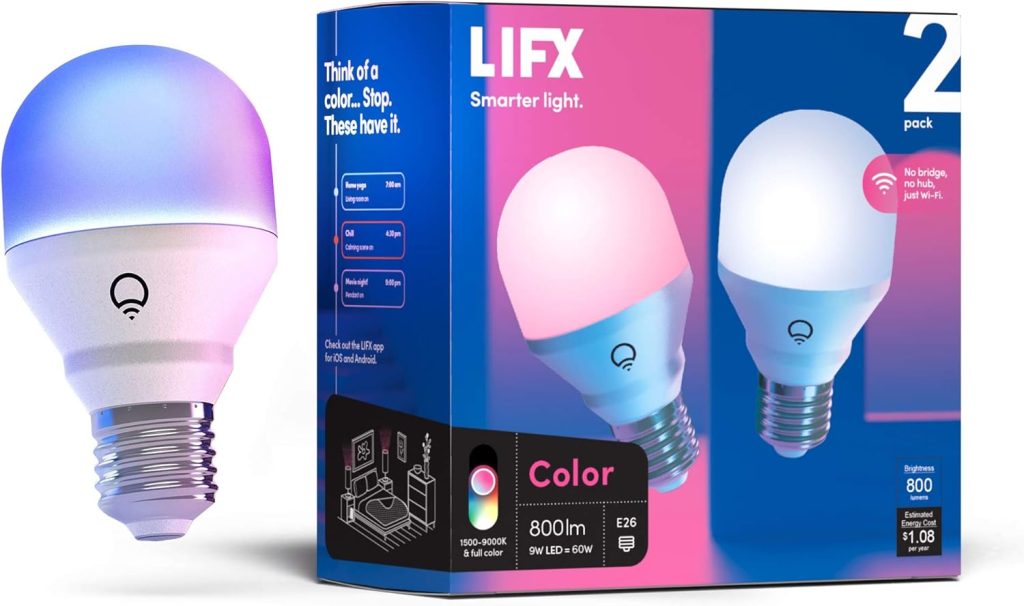
LIFX delivers the most vivid colours of any hubless smart bulb I’ve tested.
The A19 Color produces 1,100 lumens with a colour gamut that’s noticeably wider than Govee’s or GE Cync’s. Red is deeper, blues is richer, and the tuneable whites are smooth across the full 1,500K–9,000K range.
Crucially, LIFX works natively with Alexa, Google Home, and HomeKit without any hub or bridge. That three-ecosystem compatibility at $35 per bulb makes it a strong choice for mixed-brand households.
The LIFX app also supports polychrome effects, displaying multiple colours on a single bulb simultaneously, which adds visual depth you won’t find in most competitors.
The downside is price-per-bulb and Wi-Fi dependency. At $35 each, outfitting a full house gets expensive quickly.
Since each bulb connects directly to your router, adding more than 15 LIFX bulbs can stress a consumer-grade router. For large installations, Hue’s Zigbee mesh or Nanoleaf’s Thread mesh will be more stable.
- Best for: Colour enthusiasts who want vivid lighting without any hub, mixed-ecosystem households
- Works with: Alexa, Google Home, HomeKit
- Honest limitation: Expensive per bulb, Wi-Fi only (no mesh), can strain router in large setups
6. Philips Hue Essentials A19 — Best Mid-Range Smart Bulb
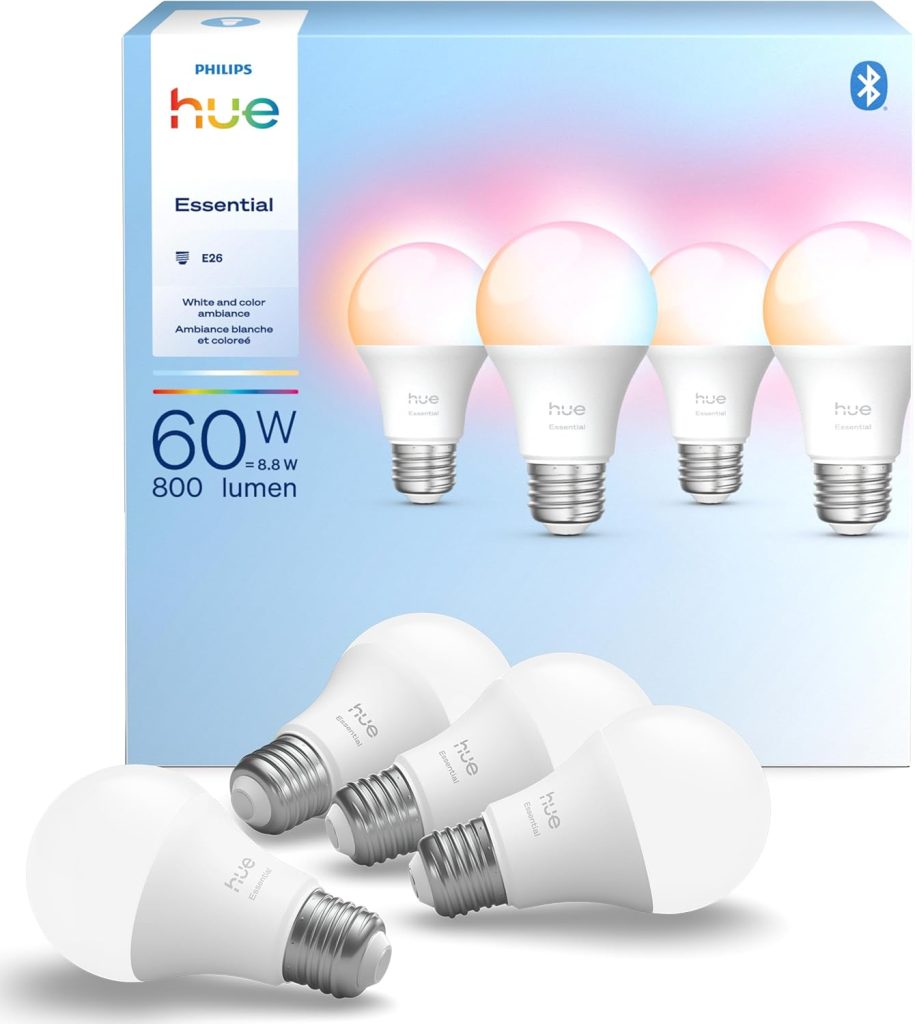
Philips launched the Hue Essentials line in late 2025 as a more affordable entry to the Hue ecosystem, and it immediately became one of the best smart bulbs for people who want Hue quality without the Hue price.
At $25 per bulb, half the cost of the standard Hue colour, it delivers the same 1,100 lumens, the same Zigbee reliability, and works with the same Hue app and Bridge.
TechRadar tested these and found them “comparable in every way except dimming.” The Essentials dim to about 5% while the originals reach 1%.
For most practical purposes, that difference is invisible. You still get 16 million colours, tuneable whites, Alexa/Google/HomeKit support, and the full Hue automation ecosystem.
This is the bulb I now recommend to anyone who says, “I want Philips Hue but can’t justify $50 per bulb.”
At $25, you can outfit a full room for the price of two premium Hue bulbs, while staying in the same ecosystem with the same app and the same bridge.
- Best for: Hue ecosystem buyers who want to outfit multiple rooms affordably
- Works with: Alexa, Google Home, HomeKit, SmartThings, Matter (via Bridge)
- Honest limitation: Minimum dimming is slightly higher than standard Hue — negligible for most users
7. Sengled Smart LED with Motion Sensor — Best Smart Bulb for Outdoor/Security
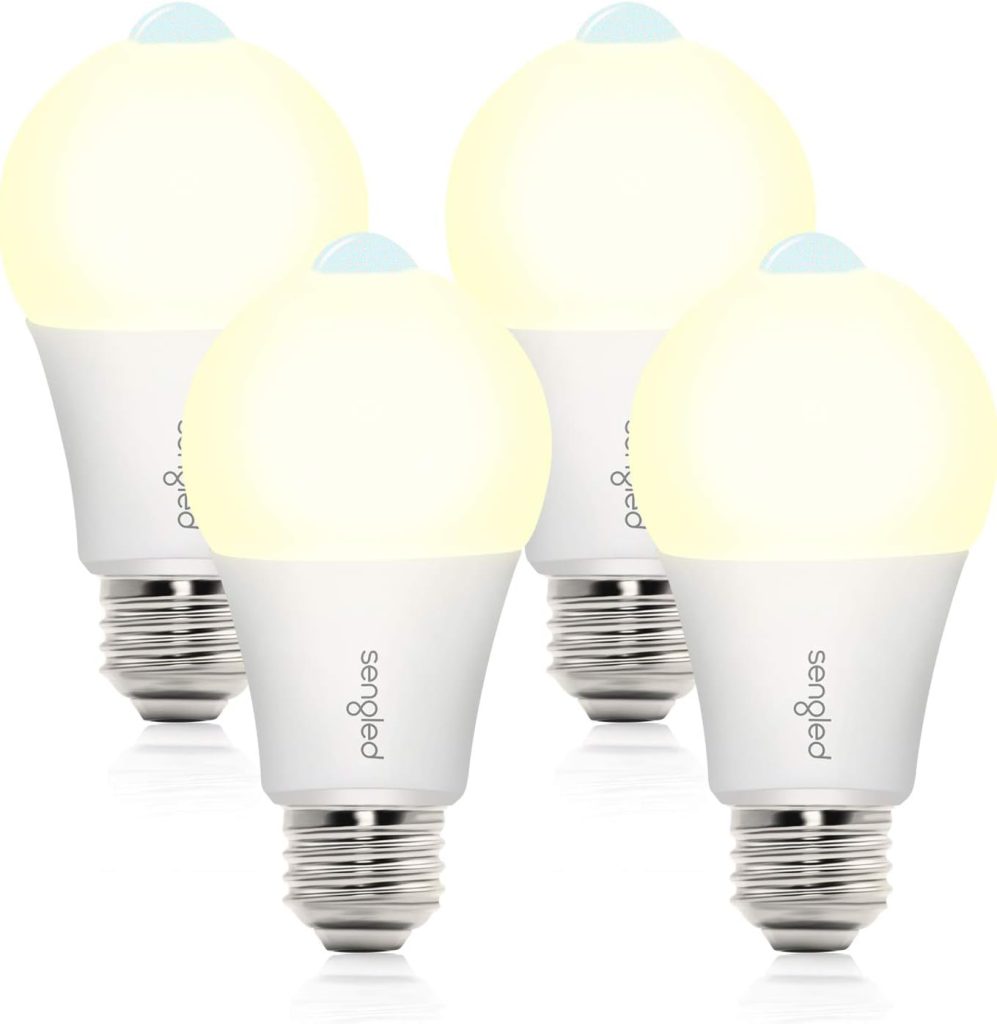
Most smart bulbs are designed for indoor use. The Sengled Smart LED PAR38 is built for outdoor fixtures. It’s weatherproof, produces 1,200 lumens of bright white light, and has a built-in motion sensor that detects movement within 30 feet.
When it senses motion, the bulb automatically turns on for 90 seconds without needing any separate sensor hardware.
This makes it excellent for driveways, porches, and backyards where you want motion-activated lighting without installing a full security light.
It requires a Zigbee hub (Sengled Smart Hub, SmartThings, or an Echo with built-in Zigbee), but once connected, it integrates into your Alexa routines naturally.
You can set it to send a notification to your phone every time motion triggers the light a simple security layer.
- Best for: Outdoor use, motion-activated security lighting, driveway and porch fixtures
- Works with: Alexa, SmartThings (via Zigbee hub)
- Honest limitation: Requires a Zigbee hub, white light only (no colour)
8. GE Cync Dynamic Effects — Best Smart Bulb for Entertainment
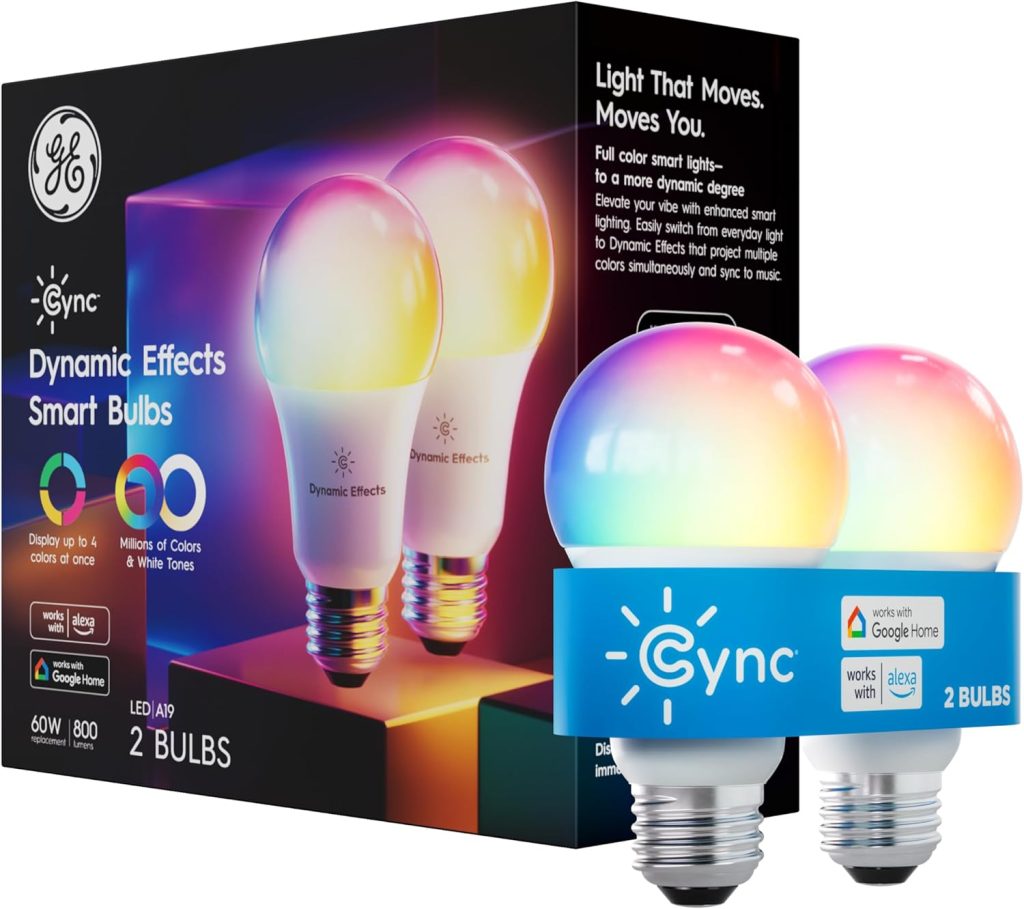
The GE Cync Dynamic Effects bulb does something no other bulb on this list can: it displays four different colours simultaneously on a single bulb.
Half green and half blue, three-quarters red with a touch of orange, checkered purple and yellow the segmented LED design creates effects that are genuinely eye-catching for gaming rooms, entertainment areas, and parties.
CNN Underscored highlighted this as a standout feature in their testing, and I agree that when mounted in a transparent or semi-transparent shade, the multi-colour effect is striking.
Beyond the party trick, the Cync app provides solid everyday functionality, including schedules, scenes, and voice control through Alexa and Google Home.
The caveat is that the Cync app has reliability issues — multiple reviewers report occasional connectivity drops and slow response times. The bulb hardware is good, but the software lets it down compared to the Tapo or Hue apps.
- Best for: Gaming rooms, entertainment areas, and anyone who wants multi-colour effects on a single bulb
- Works with: Alexa, Google Home
- Honest limitation: App reliability is inconsistent, no HomeKit support
9. Kasa KL110 Dimmable — Best White-Only Smart Bulb
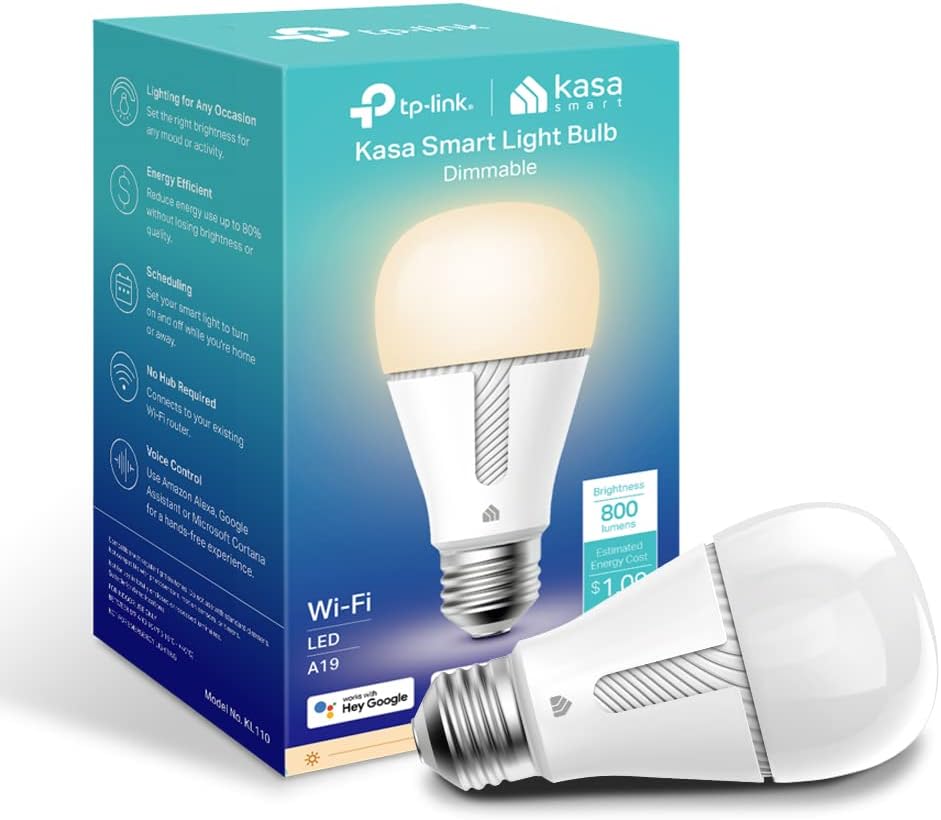
Not every room needs colour. For hallways, closets, bathrooms, and utility spaces, a simple dimmable white smart bulb does the job at a fraction of the cost.
The Kasa KL110 connects over Wi-Fi with no hub required, dims smoothly from 1% to 100% in 1% increments, and costs around $13.
The Kasa app is clean and reliable. TP-Link has been making networking hardware for decades, and their app reflects that experience.
You get scheduling, sunrise/sunset triggers, and away mode (random on/off to simulate presence while you’re out). Voice control works through Alexa and Google Home.
At 800 lumens, this isn’t the brightest option on the list, but for a white-only utility bulb at $13, it delivers exactly what you need without any unnecessary features driving up the price.
- Best for: Hallways, closets, and utility spaces where colour is unnecessary
- Works with: Alexa, Google Home
- Honest limitation: White only — no colour or tuneable white temperature
10. AiDot Linkind Matter A19 — Best Ultra-Budget Matter Bulb
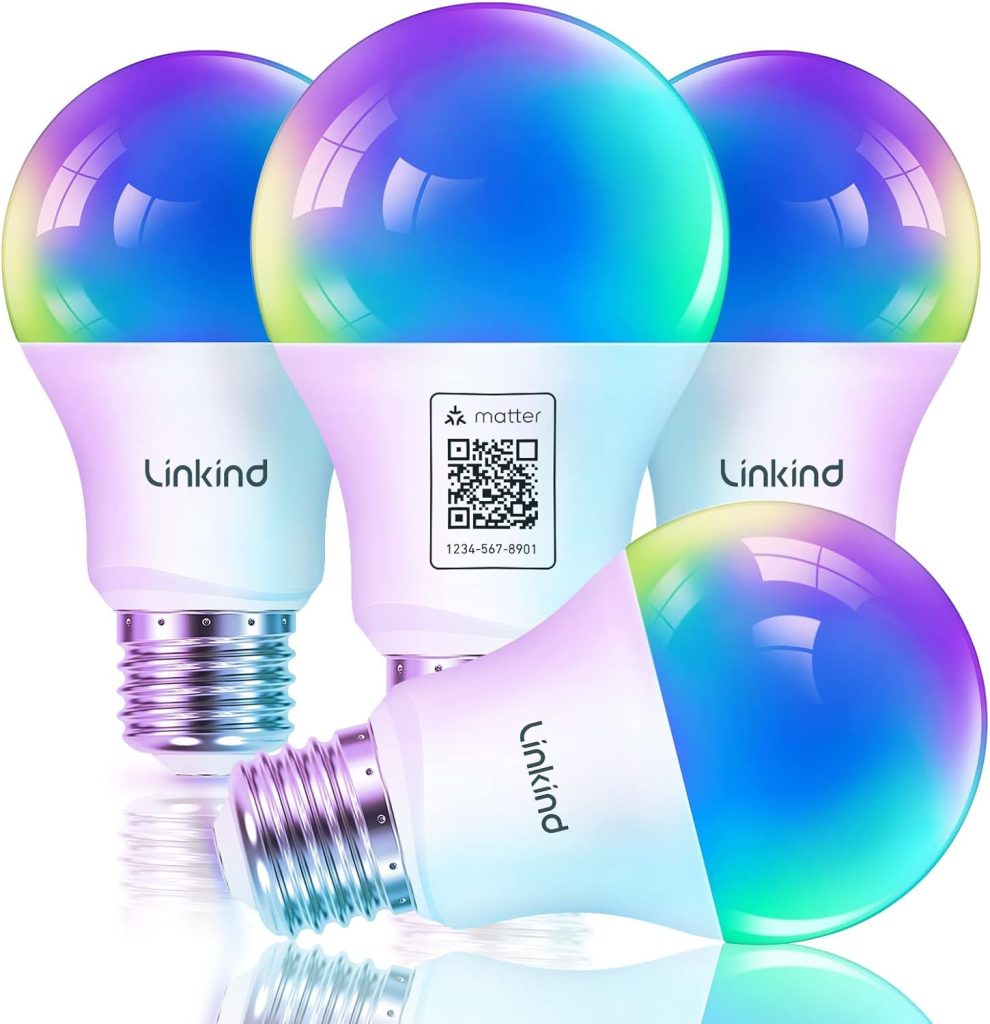
At roughly $8 per bulb, the Linkind Matter A19 is the cheapest Matter-certified smart bulb you can buy.
The Smart Home Hookup tested it extensively and rated it among the top two budget smart bulbs available praising its reliability at 800 lumens, near-zero flicker, and Matter-over-Wi-Fi connectivity that works across Alexa, Google Home, HomeKit, and SmartThings.
For anyone who wants cross-platform compatibility without spending more than $10 per bulb, this is the pick.
The colour temperature is tuneable warm-to-cool white (no full RGB colour), which makes it ideal for general lighting rather than accent or mood lighting. Setting up through any Matter controller takes under a minute.
The trade-off is that it maxes out at 800 lumens fine for table lamps and side lights, but not bright enough for main room lighting where you’d want 1,100+ lumens.
For budget buyers who need colour, see our cheap smart bulbs guide which covers colour options under $15.
- Best for: Budget buyers who want Matter compatibility, supplementing a larger setup with affordable bulbs
- Works with: Alexa, Google Home, HomeKit, SmartThings (via Matter)
- Honest limitation: 800 lumens maximum, tuneable white only (no colour)
Smart Bulbs vs Smart Switches: Which Should You Buy?
One question I get constantly from readers: Should I buy smart bulbs or smart switches? The answer depends on the fixture.
Use smart bulbs for table lamps, bedside lamps, and accent lighting where you want colour control or individual bulb customisation. Smart bulbs give you colour, dimming, and scheduling per-bulb but they lose all smart functionality when someone flips the wall switch off, because they need power to stay connected.
Use smart switches for overhead ceiling fixtures, hallways, and any room where multiple people might flip the physical wall switch. A smart switch replaces the switch itself, keeping power flowing to the fixture at all times while adding smart dimming and scheduling. For our recommendations, see the best smart light switches guide.
For most homes, the best approach is a combination: smart bulbs in lamps and accent fixtures, smart switches for overhead lighting. This gives you the best of both worlds without the frustration of dead smart bulbs after someone hits the wall switch.
Frequently Asked Questions About Smart Bulbs
Do smart bulbs work with normal light switches?
Yes, smart bulbs fit into standard E26/E27 sockets and work with regular switches. However, if someone turns the wall switch off, the smart bulb loses power and can’t respond to app or voice commands until the switch is turned back on. For overhead fixtures where people regularly use the wall switch, a smart switch is a better investment than smart bulbs.
Do smart bulbs use electricity when turned off?
Yes, but very little. Smart bulbs draw roughly 0.5 watts in standby mode to maintain their wireless connection. That’s about $0.50–$1.00 per bulb per year in electricity negligible compared to the energy savings from LED efficiency and the ability to automate scheduling so lights aren’t left on unnecessarily.
Which smart bulb protocol is best in 2026?
For most people, Matter-over-Thread is the best protocol for new smart bulb purchases in 2026 because it works across all major ecosystems (Alexa, Google, HomeKit, SmartThings) while running on a low-power mesh network. Zigbee remains excellent if you’re already in the Philips Hue ecosystem. Wi-Fi bulbs are the simplest to set up, but can strain your router in larger installations.
How many smart bulbs can my Wi-Fi router handle?
Most consumer routers start experiencing congestion at 30–40 connected devices total, including phones, laptops, tablets, and smart home devices. If you plan to install more than 10–15 Wi-Fi smart bulbs alongside your other devices, consider switching to Zigbee (Philips Hue) or Thread (Nanoleaf) bulbs that run on their own mesh network and don’t touch your router at all.
Are expensive smart bulbs worth it over budget ones?
For 1–3 bulbs in lamps, budget options like Govee or AiDot Linkind work well. For 10+ bulbs across multiple rooms, investing in Philips Hue or Nanoleaf pays off in reliability, faster response times, and mesh networking that doesn’t strain your Wi-Fi. The best smart bulbs for a whole-house setup are the ones you never have to troubleshoot, and that reliability premium is where Hue and Nanoleaf justify their higher prices.
The Bottom Line
The best smart bulbs in 2026 are better and cheaper than they’ve ever been. Matter has made ecosystem lock-in largely a thing of the past, Thread mesh networking has solved the Wi-Fi congestion problem, and prices have dropped to the point where you can outfit a room with colour-changing bulbs for under $40.
For most people, I recommend starting with one of three paths: the TP-Link Tapo L535E at $13 per bulb if you want the best value, the Nanoleaf Essentials A19 at $20 if you want Matter and Thread future-proofing, or the Philips Hue Essentials at $25 if you want to buy into the most reliable smart lighting ecosystem on the market.
Whichever you choose, start with 2–3 bulbs in one room, get comfortable with the app and voice controls, and expand from there. A smart home is built one room at a time, and smart lighting is the room that makes the biggest difference first.
Related Guides on SmartHomeDock
- 10 Best Smart Bulbs for Alexa — Alexa-specific picks with routine integration tips
- Google Smart Light Bulbs: Buyer’s Guide — Google Home and Nest-specific recommendations
- 10 Cheap Smart Bulbs for Your Smart Home — Every pick under $20
- Best Smart Light Switches in 2025 — When a switch is better than a bulb
- Everything You Need to Know About Smart Light Strips
